

Photo: Office of Senator the Hon Penny Wong
What is happening?
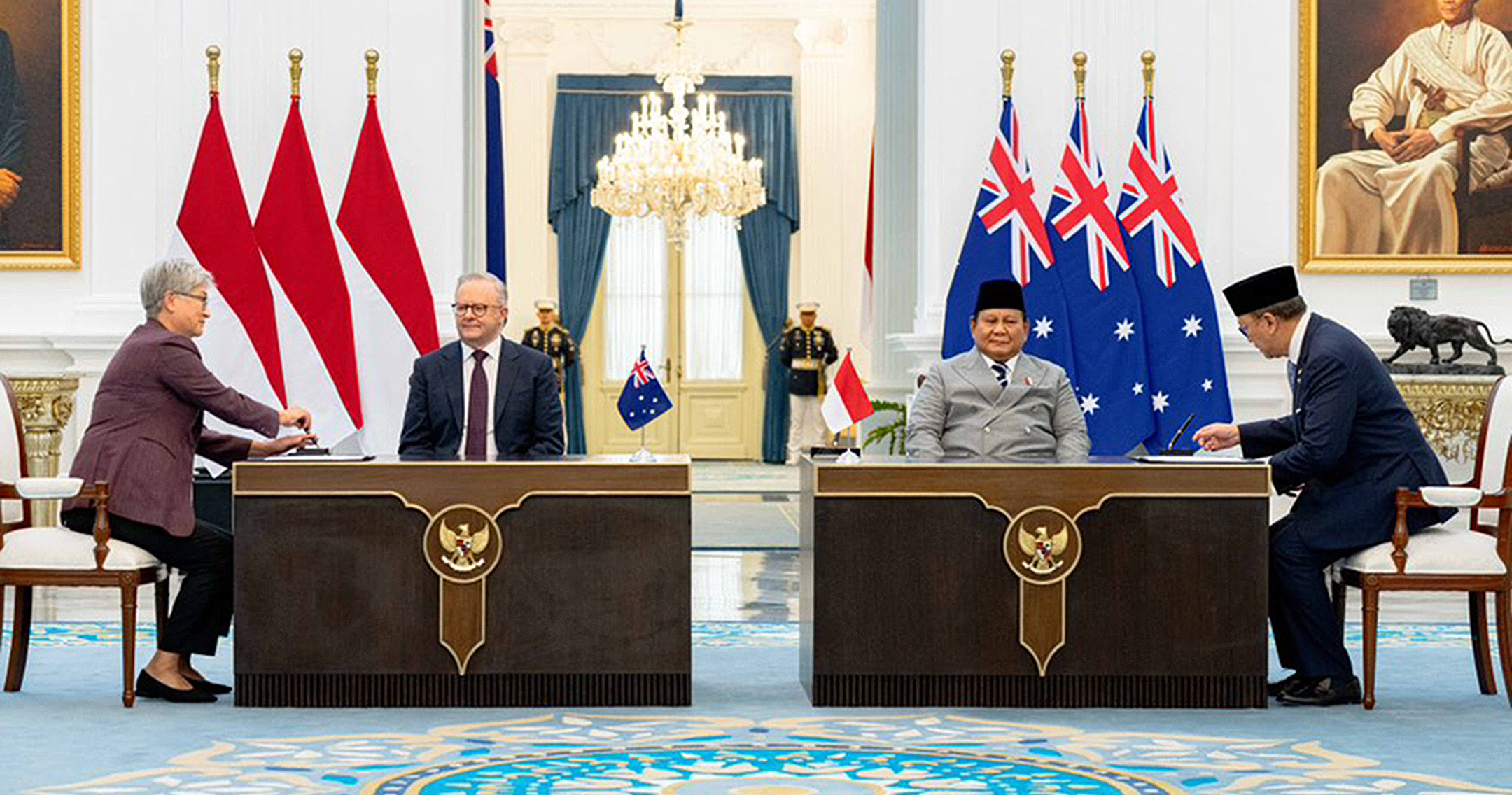
Australia is rapidly expanding security cooperation within its immediate neighborhood, placing Indonesia at the center of this effort. In early 2026, Canberra and Jakarta signed a landmark security treaty institutionalizing consultations, joint planning, and expanded military cooperation, including training initiatives and potential shared facilities.
The agreement reflects a long-overdue effort to stabilize a bilateral relationship that has been historically skewed in Canberra’s favor, despite Indonesia’s centrality to Australia’s strategic geography. It comes amid growing Chinese assertiveness and uncertainty about long-term U.S. commitments in the region.
Crucially, the framework is already expanding: Japan and Papua New Guinea are being folded into broader cooperative formats, signaling a shift toward flexible, minilateral security webs.
What is the broader picture?
Australia’s push reflects a deliberate “neighborhood first” strategy, originally launched under the first administration of Prime Minister Anthony Albanese, which entered office in 2022 with a clear mandate to rebuild ties with Southeast Asia. The Australia-Indonesia Treaty on Common Security is thus not an isolated development but a cornerstone of a broader recalibration that prioritizes regional trust-building, institutionalized cooperation, and practical defense coordination over abstract alliance politics.
As Foreign Minister Penny Wong noted, “This treaty is about being there for each other in challenging times, and strengthening the foundations of our cooperation.” Indonesian President Prabowo Subianto echoed this framing, emphasizing “good neighbor” principles and Jakarta’s long-standing non-aligned foreign policy tradition. Together, these statements underscore a shared preference for consultative security arrangements rather than rigid alliances.
Analytical commentary suggests the treaty’s real value lies less in immediate military transformation and more in political signaling and habit-building. Some observers warn of a potential “placebo effect,” where institutional frameworks risk outpacing operational substance, while others highlight gaps in implementation and interoperability.
Yet the broader trend is unmistakable: middle powers are opting for flexible, layered cooperation. Rather than joining formal blocs, Australia and Indonesia are constructing overlapping security “webs”— consultative, modular, and expandable. The inclusion of Japan and PNG illustrates this logic, as Canberra experiments with minilateral formats that can scale without provoking regional sensitivities.
At the same time, Australia is attempting to balance security ambitions with economic engagement, particularly in Southeast Asia, where partners remain wary of overt militarization. This balancing act reinforces the emphasis on non-threatening, cooperative frameworks rather than alliance-centric architectures.
In short, Canberra is repositioning itself as a regional anchor — not by building a bloc, but by weaving a network.
Why is it important?
Australia’s regionally anchored strategy does not preclude a broader global role — if anything, it may enable it. European Commission President Ursula von der Leyen’s planned visit to Australia (March 23–25) aims to deepen ties with a “trusted, like-minded partner” in the Indo-Pacific, with trade at the forefront but security cooperation increasingly on the agenda. Reports suggest a potential EU–Australia security pact, including joint naval operations, is under consideration.
For Europe, this presents both an opportunity and a constraint. Australia’s focus on “neighborhood first” means its resources and attention are increasingly tied to Indo-Pacific minilateral frameworks. Yet precisely because Canberra is emerging as a regional security hub, it becomes a more valuable partner for Europe — one capable of linking the Euro-Atlantic and Indo-Pacific security theaters through practical cooperation rather than abstract alignment.