

Photo: Public domain image – Official White House Photo by Daniel Torok
What is happening?
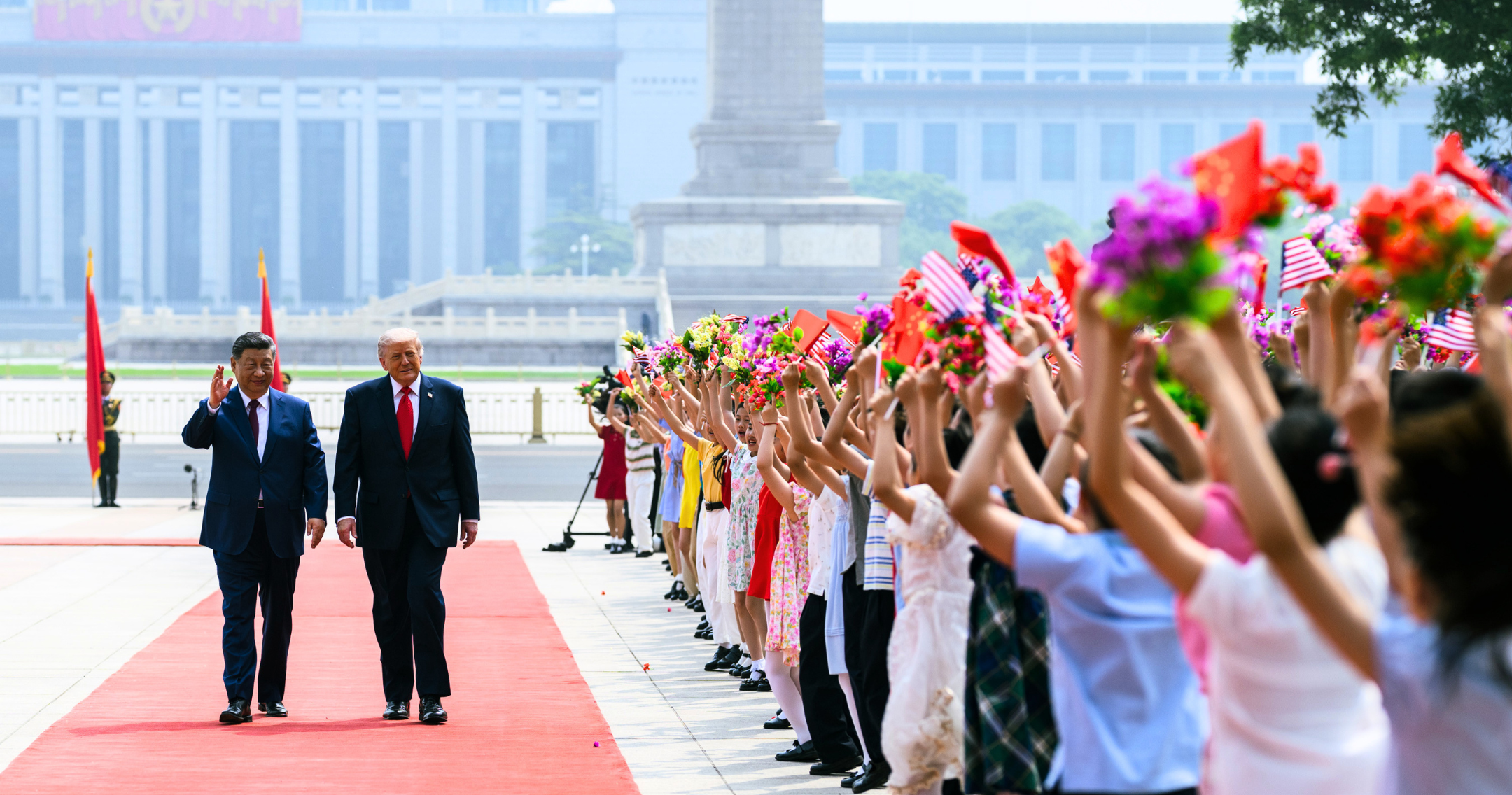
U.S. President Donald Trump and General Secretary of the Chinese Communist Party Xi Jinping (習近平) met in Beijing on May 14, with both sides framing the summit as a step toward strategic stability. The White House readout emphasized economic engagement, including in strategic sectors such as rare earths, and politically sensitive ones such as agriculture, as well as joint cooperation to manage instability in Iran and North Korea. The Chinese readout, however, placed Taiwan at the center, quoting Xi as saying that the “Taiwan question” is the most important issue in China-U.S. relations, and warning that mishandling it could lead to “clashes and even conflicts.”
The controversy deepened after Trump’s post-summit comments. In a Fox News interview, Trump said he was “not looking to have somebody go independent,” adding that he wanted both China and Taiwan to “cool down.” He also appeared noncommittal on Taiwan arms sales, saying “we’re gonna see what happens.” Trump also said he had discussed Taiwan arms sales with Xi “in great detail,” raising concerns that this could run counter to the spirit of the 1982 Six Assurances, under which Washington pledged not to consult Beijing on this issue.
Taiwan’s Ministry of Foreign Affairs responded by stressing that U.S. officials had repeatedly emphasized that Washington’s policy toward Taiwan remained unchanged. It also reiterated that Taiwan would continue to maintain the status quo, that the Republic of China is a sovereign and independent democratic country, and that China’s military threat is the only source of regional insecurity.
What is the broader picture?
The summit does not yet mark a formal shift in U.S. policy. However, Trump’s rhetoric creates ambiguity that is not necessarily premised on strategy.
The immediate concern is not only that Trump sounded transactional about Taiwan’s security, but that his language echoed key elements of Beijing’s preferred framing: that Taiwan, under the leadership of President Lai Ching-te (賴清德) and his Democratic Progressive Party, is “going independent,” that Taipei is partly responsible for raising tensions, and that cross-strait stability depends on Washington restraining Taiwan rather than deterring Chinese coercion.
This is where discourse power matters. In Chinese political usage, discourse power (huàyǔ quán; 話語權) refers to Beijing’s ability to shape agendas, define political language, and influence how global audiences understand contested issues. In the Taiwan context, its purpose is to normalize Beijing’s aggressive claims about the self-ruled democracy: The so-called “Taiwan issue” is framed as an internal Chinese matter, “Taiwan independence” as the root of cross-strait instability, and any U.S. support for Taipei as a provocation.
Trump’s remarks risk advancing precisely this narrative. Under President Lai, Taiwan has not announced a move toward formal independence. Taipei’s position has been that Taiwan is already a sovereign, democratic polity, which seeks to maintain the cross-strait status quo. When a U.S. president publicly warns Taiwan against “going independent,” Beijing gains a discursive victory: Its language is repeated by Washington, even if U.S. policy has not formally changed.
The arms sales issue compounds the problem. Taiwan is waiting for Trump to greenlight a major weapons package, including missiles, anti-drone systems, and air defense capabilities. Treating such sales as a bargaining chip with Beijing risks undermining a critical pillar of U.S.-Taiwan security cooperation. It also gives China an incentive to keep pressing Washington to convert Taiwan’s defense needs into negotiation material.
Why is it important?
For Taiwan, the immediate stakes are practical: Delayed or politicized arms sales can weaken deterrence at a time when China is intensifying military, cyber, and gray-zone pressure. But the greater danger lies in the information domain.
Beijing is likely to weaponize Trump’s comments to reinforce the U.S. skepticism narrative (yí měi lùn; 疑美論) — the claim that Washington is unreliable, transactional, and willing to sacrifice Taiwan in a great-power deal. This is not a new line of attack. Chinese state media and online influence operations have amplified narratives questioning U.S. reliability and portraying Taiwan as a pawn in Washington’s grand strategy.
That makes words strategically consequential. Even if formal U.S. policy remains unchanged, rhetoric that blurs responsibility between a coercive China and a democratic Taiwan helps Beijing raise the temperature. For Taiwan and its partners, the task is not only to secure weapons, but also to defend the vocabulary of the status quo: China is the coercive actor; Taiwan is not the provocateur.