

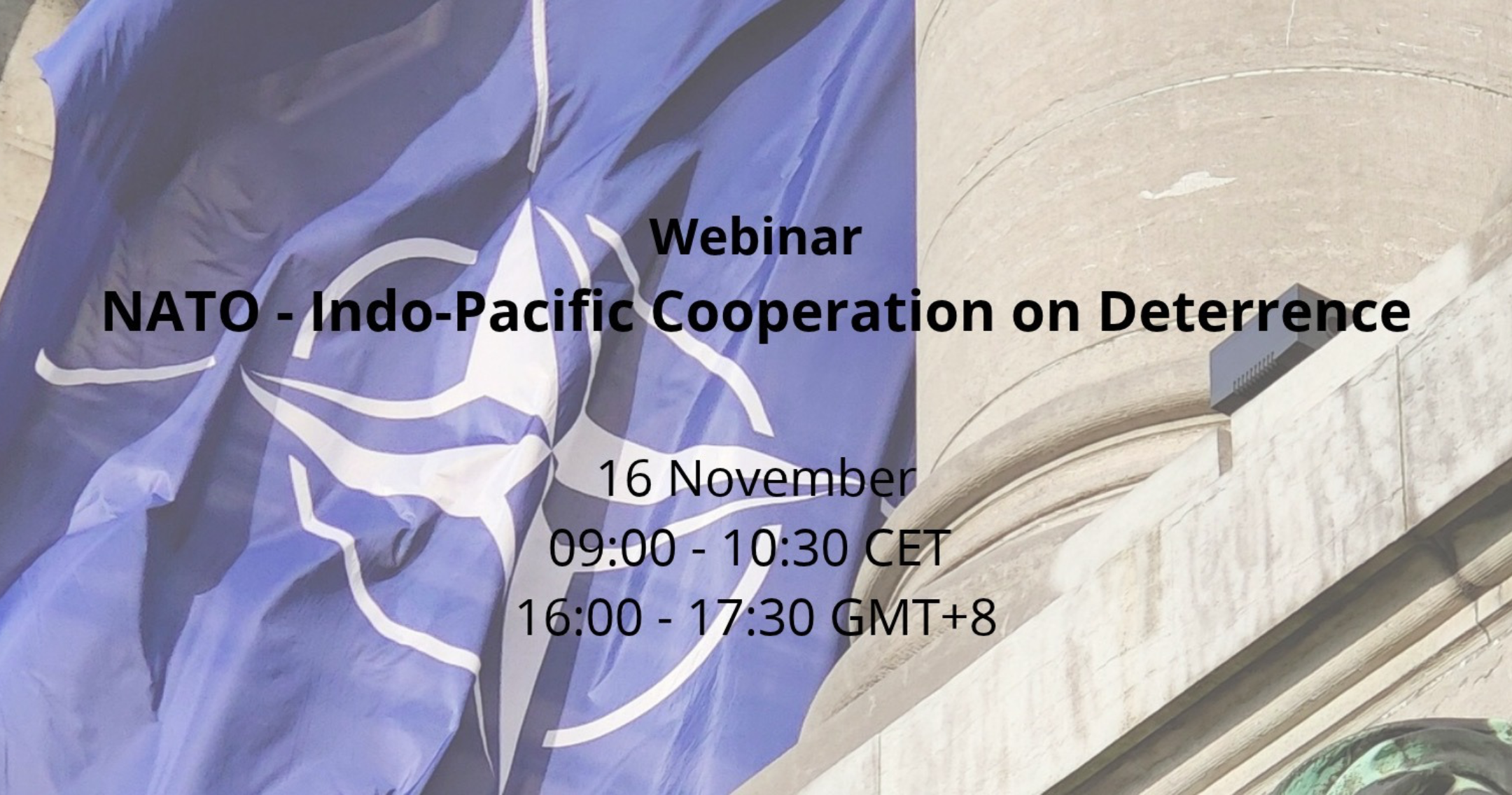
On 16 November, 2026, the European Values Center for Security Policy hosted webinar „NATO – Indo-Pacific Cooperation on Deterrence“, with the support of the Indo-Pacific and Euro-Atlantic Hub for Shared Security Challenges, a project funded by NATO’s Political Affairs and Security Policy Division.
Moderator:
- Olimpia Kot – Senior project coordinator and analyst at the European Value Center for Security Policy
Speakers:
- Alex Bristow – Senior analyst at the Australian Strategic Policy Institute.
- John Hemmings – Director of the National Security Centre at the Henry Jackson Society in London
- Akira Igata – Project lecturer at the University of Tokyo’s Research Centre for Advanced Science and Technology
- Angela Stanzel – Senior associate in the Asia Research Division at the German Institute for International and Security Affairs in Berlin
As NATO has been shifting focus back to collective defense, development in Indo-Pacific has raised question about how security issues in Asia and Europe are connected. This webinar asked mainly what we can learn from each other and flowed in great agreement of speaker over each other’s remarks.
First speaker Angela Stanzel has brought attention to that a closer cooperation between NATO and its Indo – Pacific partners have been for a long time objected by China. She thinks that by following very accurate analysis, China considers US transferring its military capabilities from Euro-Atlantic to Indo-Pacific threat to Chinas rise. China fears that NATO could have become global military actor and challenge their presence in Indo-Pacific as a threat. Angela Stanzel has also highlighted that Europe has very narrow military means with only a few exceptions. Which means that they are not in position to offer support to US on the Far East rather than focusing on their own eastern front. Also, that NATO created as regional defense treaty, is limited when dealing with the China challenge. But European countries with their respective political competences have more instruments against Chinese foreign policy and particularly in recent months cooperation with IP4 countries has deepened and there is potential for more.
She also spoke about that we should pay closer attention to parallels of European and Indo-Pacific in defense regarding hybrid warfare and grey zone activities from both Russia and China respectively. On that she agrees with the Australian speaker Axel Bristow. There is interconnectedness of these countries, and she thinks there would be a value to look into the results of it. We also should create our own Interconnectedness to counter it. Support of North Korea and Iran should also be taken into the equation, as the Iran war itself has an implication that has been globally felt, including
in Asia.
Next speaker Akira Igata focused mainly on Japan’s collaboration with NATO and its own military buildup, and that tangible cooperation between NATO and Indo-Pacific partners such as Japan, is expanding every year. Japan is also growing its defense capabilities and defense industry and that makes for another point of cooperation.
He once again reiterated, that adversaries in Indo-Pacific and Europe are already connected and that any contingency on the East Asian side will have significant, and not only economic impact on Europe and vice versa. How we can see in the case of Ukraine, China is enabler of the invasion and North Korea is cooperating militarily. Threats like disinformation crosses borders. Europe and Asia have a common threat that we must work towards together for our common interests. He is also of the opinion that there could be potentially more intelligence sharing, even thou there has to be a foundation built for that.
As of areas that NATO should cooperate with Japan in the future, Akira Igata mentions three. First – defense industry cooperation, where Japanese companies and startups despite interest, have often hard time accessing and fully understanding NATO standards, or they do not have the capacity to. Making the information accessible could benefit cooperation on defense industries and critical technologies. Second- Capability development. Both Japan and EU countries are diversifying supply chains for strategy goods. NATO is doing the same in defense industry and defense production, which is the area that more cooperation and complementary roles could develop with Japan and EU countries could develop. Third – renewal of the Japan-NATO ITPP that is due this year. The talks are already going on and, in this area, continued transparency and clearer priorities could be in his opinion greatly beneficial for involvement of private sector resources.
Beginning in more of a soft power cooperation theme, Alex Bristow, speaking from Australian point of view, conveyed an importance to stand up to China’s narrative for building links between European and Indo-Pacific security. Involvement from China in slowing the building of these links can be apparent in the case of NATO office in Japan, as previously mentioned by Angela Stanzel. Regarding closer Australia and NATO collaboration, there’s been a recent narrative of China that this will be setting up an Asian NATO and other countries in the region may share this view. He believes that it should be tested more robustly. Australia also should raise attention to and regard Russia as a direct threat in pacific, because they, in fact, have a significant naval presence there.
The baseline is that Australia has been building up its collective defense with geographically closer partners but quite differently than the NATO model.
Regarding what can Australia learn from its NATO partners, apart from collective defense, he spoke about military readiness. Australia has learned verry quickly from Russian aggression and has been sending aid to Ukraine from the beginning. Although Alex Bristow also expressed a worry that in Australia, there will be some backsliding on Russia due to international politic supported by Russian disinformation. Concerning military readiness, it is good to look to Poland and Nordic countries and see what is there to be learned. In the opposite direction, Europe can learn from Australia is experience from dealing with Chinese coercion. The narrative is that Australia has won this “battle of wills” but it is more nuanced, but it has been able to mitigate trade threats. There still needs to be more willingness to call out misconduct in Chinas diplomacy from political class so it doesn’t fall only on the academics.
What we can learn from each other and what is, in his opinion, valuable as a two-way street, is information exchange on how to counter hybrid threats. And we all could do more on sea lane security, where for example trade through Suez Canal is very important for both NATO and Indo-Pacific partners.
Last speaker, John Hemmings spoke mainly about defense cooperation and defense industrial cooperation between NATO member states and Indo-Pacific partners. This cooperation is largely facilitated by US PACOM and has been flourishing since 2017 when China started building artificial islands in South China Sea and that can be seen for example by increase in number of countries with Liaison officers at PACOM. Dispite the tone from current US administration, activities have bean taking place and that also outside of US, as he gave example of UK aircraft carrier mission last year and annual French mission to the region. Meaning of presence of liaison officers doesn’t come with any fighting responsibilities, but it makes involved countries very aware of US plans. In his opinion, that enables them to some level of defense industry cooperation by the ability to look downstream considering their own capabilities.
US has been creating framework with its allies and partners firstly for sustainment of US forward deployment. John Hemmings highlighted for example PIPER – Partnership for Indo-Pacific Industrial Resilience, launched in 2024, that brings together 16 countries from both NATO and Indo-Pacific regions. This platform, besides aligning procurement and supply chain rules, is working on what can be brought to the table by different countries.
Overall, all speakers were in agreement on main discussion points. Towards the end of discussion, came into question balance of Indo-Pacific and NATO in more of a trilateral sense of Indo-Pacific, Europe and US balance. This not only in capabilities divide, but also in seeing different things as a priority. Talks ended in thinking about what will future bring.
FIND THE INDO-PACIFIC AND EURO-ATLANTIC HUB FOR SHARED SECURITY CHALLENGES ON LINKEDIN:
https://www.linkedin.com/company/135754447/admin/dashboard/
FURTHER READING AND WORKS MENTIONED IN THE WEBINAR:
- What NATO’s Ankara summit meant for the Indo-Pacific | The Strategist: https://www.aspistrategist.org.au/what-natos-ankara-summit-meant-for-the-indo-pacific/
- China’s new ambassador arrives in Australia – and immediately gets to work | The Strategist: https://www.aspistrategist.org.au/chinas-new-ambassador-arrives-in-australia-and-immediately-gets-to-work/
- NDS 2026 – The three ways to count Australian defence spending | The Strategist: https://www.aspistrategist.org.au/nds-2026-the-three-ways-to-count-australian-defence-spending/
- Normalising disinformation: China shifts to overt operations against Japan | The Strategist:https://www.aspistrategist.org.au/normalising-disinformation-china-shifts-to-overt-operations-against-japan/
- Hybrid Threats in the Indo-Pacific – ASPI: https://www.aspi.org.au/programs/cyber-technology-and-security/hippa/
- Joint Statement Reaffirming a Shared Commitment to Defense Industrial Resilience: https://www.war.gov/News/Releases/Release/Article/4439861/joint-statement-reaffirming-a-shared-commitment-to-defense-industrial-resilience/
- Russia’s Pacific submarine fleet: Sino-Russian cooperation in a conventional Pacific conflict – ASPI: https://www.aspi.org.au/report/russias-pacific-submarine-fleet-sino-russian-cooperation-in-a-conventional-pacific-conflict/
- The Sino-Russian partnership: why it matters for Australian security and defence – ASPI: https://www.aspi.org.au/report/the-sino-russian-partnership-why-it-matters-for-australian-security-and-defence/
- Multinational Armaments Resilience Seminar (MARS) – Daniel K. Inouye Asia-Pacific Center for Security Studies: https://dkiapcss.edu/multinational-armaments-resilience-seminar-mars/
- Marles should discuss beauty contests at the NATO summit in Washington | The Strategist: https://www.aspistrategist.org.au/marles-should-discuss-beauty-contests-at-the-nato-summit-in-washington/
- Japan aims to be indispensable to Trump. Australia should follow | The Strategist: https://www.aspistrategist.org.au/japan-aims-to-be-indispensable-to-trump-australia-should-follow/
- Brussels Defence Forum: https://www.defenceforum.org
- Podcast: A French connection: nuclear doctrine in Europe and the Indo-Pacific – ASPI: https://www.aspi.org.au/podcasts/a-french-connection-nuclear-doctrine-in-europe-and-the-indo-pacific/