

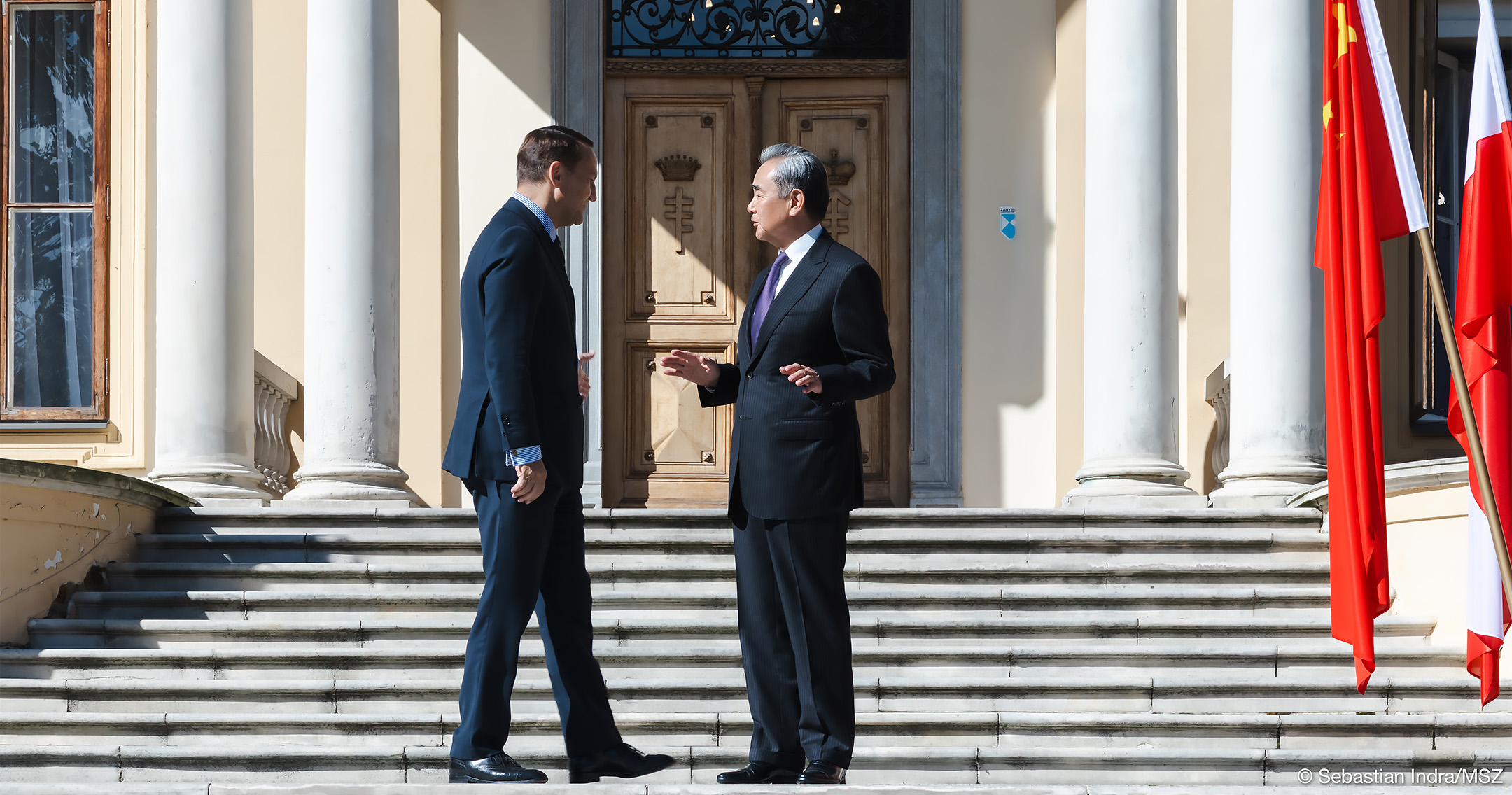
Photo: Helenów. Meeting between Chinese Foreign Minister Wang Yi and Poland’s Deputy Prime Minister and Minister of Foreign Affairs Radosław Sikorski. (By Ministry of Foreign Affairs of the Republic of Poland, CC BY-NC 4.0)
What is happening?
For the first time in six years, the foreign minister of the People’s Republic of China visited Poland. On September 15, Wang Yi (王毅) joined his Polish counterpart Radosław Sikorski to co-chair the fourth meeting of the Poland-China Intergovernmental Committee. The three-hour talks encompassed bilateral trade and investment, including agriculture, electromobility, logistics, Poland’s G20 bid, as well as global and regional geopolitical issues. Wang also met with Polish president Karol Nawrocki.
The visit took place amid Poland’s growing national security concerns, significantly intensified by the Russian drone incursion into Poland, which had occurred just a few days earlier. As China serves as a “decisive enabler” of Russia’s war against Ukraine, Sikorski raised the issue of Russian drones intruding into Polish airspace with Wang.
What is the broader picture?
Warsaw’s China calculus is in flux. Under newly inaugurated President Karol Nawrocki, Warsaw might show a tilt toward “pragmatism without principles,” a transactional China policy that prizes deals over values; yet the possible contours of such a move remain contested within Poland’s governing camp. Consequently, Wang’s visit comes at an important time of geopolitical reshuffling, which has had particularly dire consequences for Poland, a steadfast supporter of strong transatlantic relations and one of the most Kremlin-skeptical countries in the EU.
That uncertainty collided with a sharper security climate. Days before Wang arrived, Russia sent drones into Polish airspace, marking an unprecedented challenge to the North Atlantic alliance that has forced NATO intercepts and Article 4 consultations in the region. Wang’s visit was scheduled well in advance, so it would be hyperbolic to read it as a response to Moscow’s belligerence. Still, the incidents undeniably raised the political temperature around any Warsaw–Beijing engagement.
At China’s 80th WWII anniversary commemorations, the guest list—Russia, North Korea, Iran, Belarus—telegraphed tighter ties within an emerging anti-West bloc and Beijing’s ambition to reshape the international order. That context could narrow the space for meaningful expansion of Polish-Chinese ties while war rages next door in Ukraine.
A second test sits on Poland’s eastern frontier. Warsaw has closed the border with Belarus amid the Russia-Belarus Zapad-2025 drills, halting flows through a corridor that carries a substantial share of China–EU rail freight. The decision fits Poland’s hard-security posture but instantly turns trade logistics into geostrategy—and gives Beijing a practical grievance even as it courts Warsaw.
Yet China is unlikely to accept a choke point as fate. Shippers can re-route via the “Middle Corridor” (Trans-Caspian links across Central Asia, the Caucasus, and Türkiye) that bypasses Russia and Belarus. While costlier and capacity-constrained, the corridor has been expanding and is explicitly framed as a resilience hedge for Eurasian trade. Notably, its expansion is one of the key items on the agenda of the upcoming second Global Gateway Forum, highlighting its relevance to the EU itself. In practice, that means Poland’s decision to keep its border with Belarus sealed cannot, by itself, throttle China–Europe flows. Therefore, analysts emphasize that despite its decision to block the inflow of China-EU rail cargo through its border with Belarus, Poland has virtually no leverage over China to (re)shape its relations with Russia.
Why does it matter?
Notably, the assessment of possible practical results of the meeting between Wang and Sikorski and Nawrocki is complicated by the fact that both sides did not issue a joint statement following the talks. Yet, one dynamic is clear: While they discussed increasingly difficult dynamics in Poland-Russia relations amid the latter’s full-scale war of aggression in Ukraine, they were talking past each other rather than to each other to seek consensus. Beijing appears likely to continue its approach of “pro-Russian neutrality.”
Meanwhile, the Polish government continues to maintain its arguably naïve stance of courting China to support its cause. For example, foreign minister Sikorski expressed the view that, should Poland decide to reopen its border with Belarus, it will seek Beijing’s help in curbing migration across that boundary. This is based on the claim that Russia instrumentalizes irregular population flows as a hybrid tactic of coercion towards Poland. Nevertheless, there are minimal signs that Warsaw has any meaningful leverage vis-à-vis Beijing, nor are there any indications that it would be in Beijing’s strategic interest to align with an EU member state over Moscow and Minsk. While consistent with Poland’s long-standing policy of light hedging amid great power competition, this approach of the current government ultimately weakens its potential to lead a more nuanced and principled EU-wide approach to Beijing amid critical security challenges in Europe.