

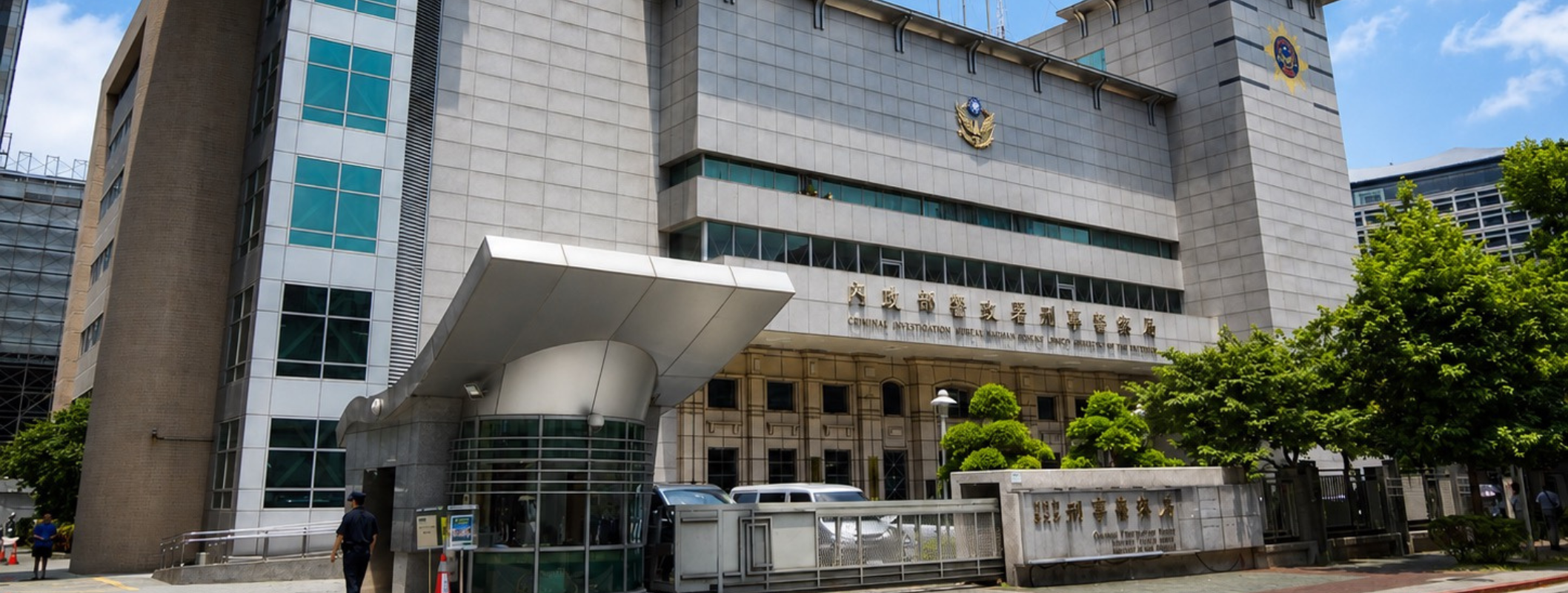
Photo: Criminal Investigation Bureau, Taiwan. Source: Wikimedia Commons
When the world marks the International Day Against Drug Abuse and Illicit Trafficking on June 26, law enforcement agencies will celebrate cooperation as the antidote to transnational crime. Yet, one of the Indo-Pacific’s most capable policing partners will, once again, be locked out of the room. Taiwan has been excluded from Interpol since 1984, and that exclusion is not the passive, regrettable gap it is often described as. It is a door Beijing deliberately built and bolted shut: an act of coercive lawfare that degrades global security while advancing the fiction that Taiwan does not exist.
The mechanics are worth recalling, because they reveal intent. Taiwan was an Interpol member from 1961 until 1984, when the organization recognized the People’s Republic of China (PRC) as the sole representative of China. Since then, as neither member nor observer, Taiwan cannot access Interpol’s I-24/7 communications network or its 19 criminal databases. When Interpol’s 93rd General Assembly convened in Marrakech in November 2025, Taiwan was shut out once more, despite a sustained campaign by its diplomatic partners for observer-level access. Cut off from real-time data, Taiwan’s own police authorities report that the intelligence they can obtain is often “out of date and incorrect,” and that they are forced to rely on the police forces of friendly countries to relay alerts on their behalf. On World Drug Day the cost comes into focus, as synthetic-drug precursors, laundering networks and trafficking routes move through the Indo-Pacific faster than those workarounds can follow. The blind spot is mutual, when Taiwan cannot transmit an urgent alert, every member state loses the intelligence it would have carried, and the gap becomes one Beijing has engineered into everyone’s security.
What makes this more than a procedural dispute is the way exclusion operates alongside abuse. Beijing invokes the “One China” principle to bar Taiwan from any body that implies statehood, yet treats the same institution as a weapon when it suits. Interpol has been repeatedly weaponized against the diaspora — textbook transnational repression — with Red Notices and diffusions deployed against dissidents, Uyghur activists and former officials who expose corruption, often to coerce “voluntary” returns by pressuring relatives back home, a pattern that continues to draw scrutiny in 2026. The same logic reaches Taiwanese nationals abroad: In disputes from Kenya to Spain, fraud suspects holding Taiwanese passports have been deported to the PRC rather than to Taipei, with Beijing asserting jurisdiction over people Taiwan regards as its own. Repression of individuals and erasure of the polity are twin faces of a single project, and the exclusion does the quieter work in the form of cognitive warfare. A door kept shut long enough makes people forget anyone was meant to walk through it, and the same erasure across the Worls Health Organization, the International Civil Aviation Organization, and every comparable forum gradually turns absence into the appearance of non-existence. Each exclusion becomes the precedent for the next.
The most effective rebuttal to that narrative is that cooperation with Taiwan plainly works. Locked out of the multilateral system, Taipei has built its own web of bilateral judicial arrangements, anchored by a mutual legal assistance agreement with the United States, and extended through joint investigation, asset-forfeiture and videoconference-hearing mechanisms with European partners including Poland and Germany. The results are operational, not theoretical. Working with Montenegro in 2020, Taiwanese police helped arrest 92 suspects who had defrauded more than 2,000 victims; parallel operations with Turkey and Vietnam followed against rings coercing migrants into scam compounds. Taiwan’s cyber units and counter-narcotics police also sit astride the fraud and money-laundering networks now metastasizing in Southeast Asia. Momentum is building on the political track too, with bipartisan U.S. legislation introduced in November 2025 directing the State Department to develop a strategy for Taiwan’s Interpol membership, while observer status remains the realistic compromise.
For European partners, the lesson is direct. Every bilateral arrangement signed with Taipei chips away at the premise that Taiwan can be safely erased, and every forum that names the problem refuses Beijing the silence its strategy depends upon. The locked door at Interpol is not a sign of Taiwan’s failure to qualify, it is a vulnerability Beijing engineered into the shared security of democracies. The question facing those democracies is not whether to do Taiwan a favor, but whether they will keep treating its participation as a concession to be debated or recognize it for what it is: protection against a threat that is already at their doorstep.
Athena Tong
Athena Tong is a Visiting Researcher at the University of Tokyo, Research Associate and Programme Lead at the China Strategic Risks Institute (CSRI), Nonresident Vasey Fellow at Pacific Forum, and an Indo-Pacific Young Leaders Program Fellow at the Asia Pacific Foundation of Canada. Her research focuses on economic security, critical infrastructure resilience, and PRC political warfare in the Indo-Pacific, with particular attention to Taiwan, Japan, and the broader regional security landscape. She was previously a Visiting Scholar at Taiwan’s Research Institute for Democracy, Society, and Emerging Technology (DSET). Her work examines the intersection of geopolitics, information resilience, and strategic competition in East Asia.