

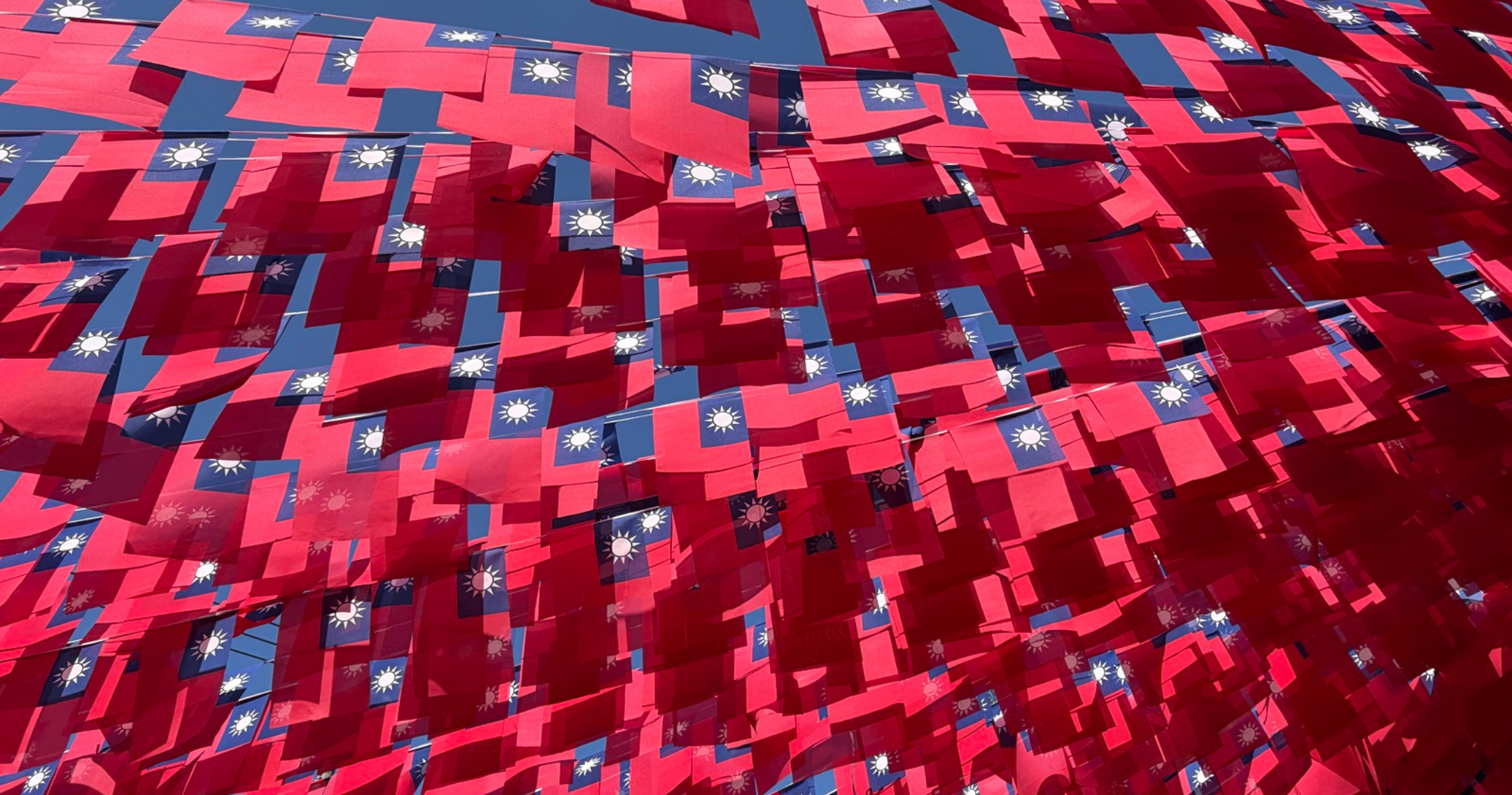
Photo: The official flag of the Republic of China (Taiwan). Photo by Olimpia Kot, EVC.
What is happening?
On October 10, President Lai Ching-te (賴清德) delivered a National Day address focusing primarily on domestic issues in Taiwanese politics. With local elections scheduled for November, the speech centered on economic performance, social welfare, housing, and the distribution of prosperity.
During his speech, on what is commonly known as Double Ten Day in Taiwan, Lai pointed to Taiwan’s AI-driven boom, with GDP growth projected to exceed 11% in 2026, the biggest increase in 39 years. He also acknowledged that these gains must reach beyond the technology sector. To that end, Lai highlighted a NT$100 billion revitalization program for small and medium-sized enterprises (SMEs), new housing measures, and a proposed universal NT$10,000 “AI dividend” next year.
Cross-strait relations took up a comparatively modest share of the address, with Lai reaffirming Taiwan’s commitment to peace and freedom and cautioning against distortions of World War II history. Following Lai’s speech, Beijing staged live-fire military exercises along its coastline, although they were markedly smaller than previous large-scale operations around Taiwan.
What is the broader picture?
The address captured a challenge of growing salience for Taiwan: Exceptional growth does not automatically yield broadly shared prosperity.
Global demand for advanced semiconductors and AI infrastructure has made Taiwan indispensable to the world’s technology supply chains. The same dynamic, however, has deepened what is often described as a K-shaped divide. Nearly 70% of workers in Taiwan earn less than the average monthly salary, while the electronics sector accounts for fewer than one in 10 jobs. Lucrative technology salaries sit alongside stagnant wages in traditional industries, high housing costs, and mounting economic anxiety among younger Taiwanese.
Lai’s policy response pairs redistribution with industrial upgrading. In addition to the proposed cash payment and housing support, the SME program offers financing, workforce training, digital transformation, and help accessing international markets. The more consequential question is whether these instruments can deliver sustained productivity and wage growth outside the semiconductor ecosystem.
The electoral calendar goes a long way toward explaining this emphasis. In November, voters will judge the government on everyday concerns, including wages, housing affordability, and public services, as much as on cross-strait security.
One passage of the address, however, carried notable geopolitical weight. Lai’s warning against distorting the history of WWII was especially pointed on Double Ten, which commemorates the founding of the Republic of China (ROC).
Beijing has increasingly mobilized wartime history to support its contemporary claims about sovereignty and the international order. As EVC Global Advisory Board Member Justyna Szczudlik recently argued in The Interpreter, the September visit to Washington by China’s President Xi Jinping (習近平) illustrated Beijing’s pursuit of discourse power (話語權) — the capacity to shape the vocabulary and historical narratives through which other governments interpret international politics. While invoking Chinese wartime assistance to American pilots, Xi passed over key aspects of the vital wartime support the U.S. provided for China.
For Taipei, the distinction is substantive. The government that led China’s resistance against Japan was the ROC. The People’s Republic of China (PRC) was not established until 1949 —four years after the end of WWII. Competing readings of that history bear directly on how Taiwan’s sovereignty and the postwar order are understood.
Following Double Ten, activity by the People’s Liberation Army (PLA) was less remarkable than on comparable occasions. The PLA has previously used the holiday period to signal displeasure with Taipei. The most visible example came in October 2024, when Joint Sword-2024B involved large-scale operations around Taiwan. This year’s drills have taken place off the coast of China’s Zhejiang province and did not include a similar encirclement of Taiwan. Some maritime notices from China’s authorities were also issued before Lai spoke, making any direct causal link difficult to establish.
Why is it important?
Lai’s address brought together two dimensions of Taiwan’s resilience that are frequently treated in isolation.
The first is socioeconomic: Technological leadership reinforces Taiwan’s international standing, but domestic legitimacy also hinges on whether growth translates into higher wages, more affordable housing, and opportunities for smaller businesses. These outcomes, more than headline GDP figures, are the appropriate measure of Lai’s proposals.
The second is historical and political. Beijing’s efforts to shape international interpretations of WWII show how discourse power can buttress sovereignty claims without altering facts on the ground. Countering them requires sustained engagement with international audiences, particularly where familiar historical terminology obscures important distinctions.
The restrained character of this year’s exercises should not distract from either challenge. This Double Ten, the most consequential questions facing Taiwan are: Who benefits from its prosperity and who gets to define its place in history?