

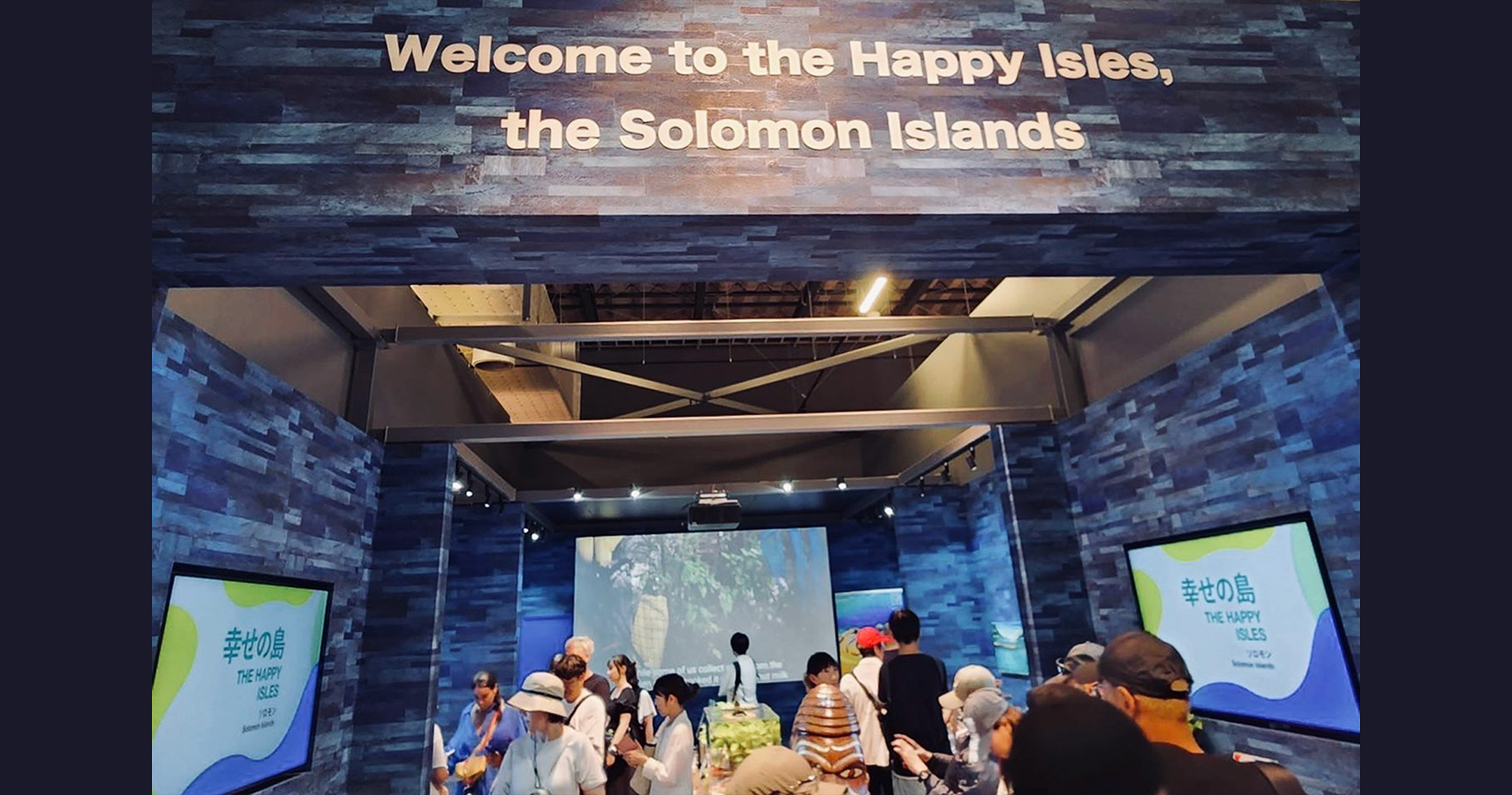
The Solomon Islands Pavilion at the Osaka Expo. Photo by Marcin Jerzewski
What is happening?
Taiwan, alongside several other non-member states, has been excluded from participation in the upcoming 2025 Pacific Islands Forum (PIF), one of the region’s most significant diplomatic assemblies. According to Solomon Islands Prime Minister Jeremiah Manele, whose government will host this year’s Forum, the exclusion is framed as part of an “ongoing review” of each country’s relationship with the Pacific. Opposition voices within the Solomon Islands, however, contend that the decision is less the outcome of bureaucratic procedure and more a response to geopolitical pressures linked to China and Taiwan.
What is the Broader Picture?
The exclusion extends not only to Taiwan but also to all other external dialogue partners, including the United States, China, the European Union, and others. This broader exclusion is widely interpreted as an attempt by PIF leaders to forestall potential diplomatic fallout that might have arisen had Taiwan alone been excluded from this year’s Forum.
Even prior to the 2025 Forum, China’s efforts to marginalize Taiwan within the Pacific Islands Forum were already apparent. During the 2024 Forum, references to Taiwan were deliberately removed from the Forum’s Communiqué. The original document, which stated that leaders had reaffirmed the 1992 decision that opened the door to Taiwan’s participation in the Forum as a development partner, was taken down and republished without the reference to Taiwan, reportedly after objections by a Chinese envoy. Thus, since last year, media reports have suggested that the Solomon Islands, China’s closest security ally in the Pacific, which broke off diplomatic ties with Taipei in favor of Beijing in 2019, would seek to exclude Taiwan from the 2025 PIF due to Chinese pressure.
The Pacific Islands Forum (PIF) was established in 1971 as the South Pacific Forum, founded by Australia, the Cook Islands, Fiji, Nauru, New Zealand, Tonga, and Samoa (then Western Samoa). Its creation reflected the recognition among these states of the need for a dedicated regional mechanism to address the most pressing political, economic, and developmental challenges confronting the Pacific at the time. Since then, it has evolved into the preeminent intergovernmental organization in the region, serving as its highest-level political and economic forum. The annual forum and its issues are based on the meetings of the Economic Ministers, Foreign Ministers, Trade Ministers, Women Leaders, Smaller Islands States Leaders Meeting and Forum Officials Committees. The Forum encompasses 18 member states and cooperates with over 20 dialogue partners.
For more than three decades, Taiwan has held the status of development partner of the Pacific Islands Forum (PIF), actively contributing to regional cooperation through financial assistance, scholarship programs, and project implementation assistance, and the work of its Taiwan Technical Missions (TTMs) under the International Cooperation Development Fund (ICDF) operating not only in Taiwan’s three remaining diplomatic allies in the Pacific but also across other states in the region.
Why does it matter?
The incident underscores the Forum’s increasingly contested position as the principal arena for regional diplomacy, highlighting both its heightened sensitivity to the Taiwan question and the growing weight of Chinese pressure on regional institutions. The Pacific Islands remain among the most aid-reliant regions globally, while simultaneously standing on the frontline of climate change as sea levels rise. At the same time, the region has become a focal point of intensifying security competition between the United States and China. The European Union has also sought to assert a more prominent role through its Global Gateway Initiative, framing engagement with the Pacific as part of its broader geostrategic calculus.
Yet these dynamics risk undermining the very regional solidarity the Forum was established to foster. Tuvalu’s Prime Minister Feleti Teo has warned that his country may withdraw from the upcoming meeting, voicing frustration that great-power rivalry increasingly overshadows the Pacific’s core development priorities. As he emphasized, the Pacific needs development assistance, but what the region does not need is competition and conflict overshadowing development agenda.
Ultimately, while the exclusion of Taiwan and other external actors may temporarily shield the Forum from diplomatic friction and project an image of safeguarding its institutional integrity and independence, for China, which probably did not anticipate being excluded from this year’s Forum, it does not preclude the continuation of bilateral engagements outside the Forum’s framework. China, will continue to secure meetings with Pacific leaders through its embassy in the Solomon Islands. For Taiwan, the outlook is doubly precarious. While it is expected to return to the Forum in 2026, when Palau, one of Taipei’s three remaining diplomatic allies in the Pacific, assumes the role of host, its participation remains contingent not on institutional guarantees but on the shifting balance of regional diplomacy under the weight of Chinese pressure.