

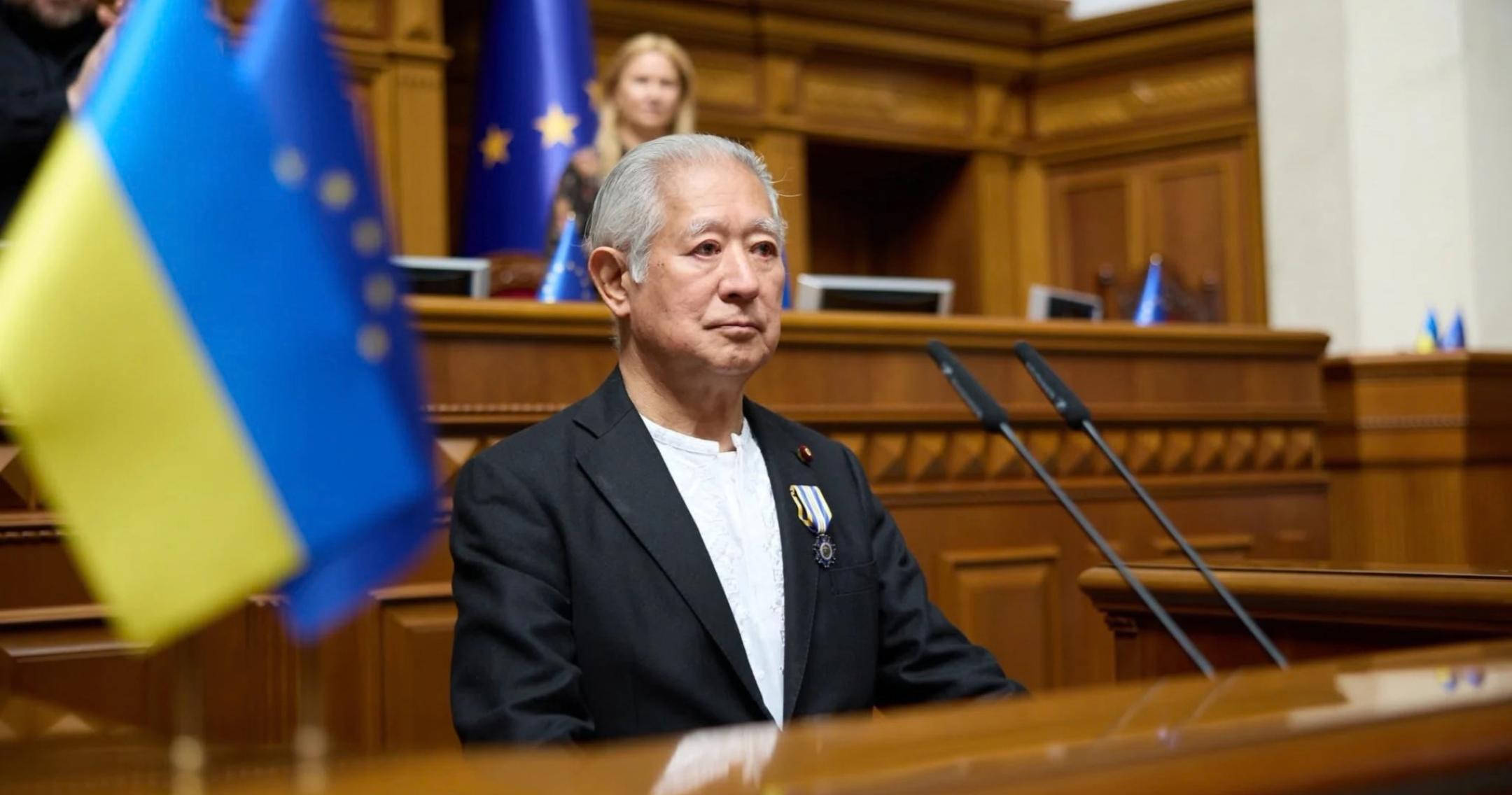
Photo: Mori Eisuke in the Verkhovna Rada. Source: Ruslan Stefanchuk, FB.
What is happening?
Addressing Ukraine’s parliament in Kyiv on September 15, Japan’s lower house speaker Eisuke Mori expressed respect and support for the Ukrainian people, while also condemning Russia’s aggression. Following his speech at the Verkhovna Rada, the speaker of Japan’s House of Representatives held talks with President Volodymyr Zelensky and parliamentary leaders on further Japanese support.
The visit is significant both as a symbolic demonstration of solidarity and an opportunity to advance practical cooperation in defense, energy and economic recovery. It is also notable for having proceeded despite Russian strong criticisms over Japan’s support for Ukraine and a recent diplomatic dispute between Tokyo and Moscow.
What is the broader picture?
Japan has been a major supporter of Ukraine since 2022, providing substantial financial, humanitarian and reconstruction assistance. Tokyo also views the war through the lens of its own security concerns in East Asia, linking its position to defending the rules-based international order and opposing unilateral changes to the status quo by force, hence the warning that “Ukraine today may be East Asia tomorrow.”
Against this background, Mori’s visit carries particular diplomatic weight. Addressing the Verkhovna Rada while wearing a traditional, embroidered Ukrainian garment, vyshyvanka, Mori demonstrated the bipartisan nature of Japan’s support, signaling continuity in its Ukraine policy regardless of changes in political leadership. On a more practical level, Mori met with several high-ranking Ukrainian officials, including the president, to discuss pressing issues.
An important topic was energy support ahead of winter. Japan has helped restore damaged energy infrastructure since 2022, financing projects through the Japan International Cooperation Agency (JICA) — the country’s official development assistance body — and other channels, supplying generators, transformers and gas-turbine equipment. Japan’s involvement in Ukraine also includes longer-term projects, such as a solar power plant built at the Chernobyl (Chornobyl) nuclear power plant. In early 2026, Tokyo announced further assistance, including 140 generators and 60 transformers, continuing its focus on Ukraine’s energy resilience.
Another topic of discussion was the effort to strengthen Ukraine’s air defenses. Japan’s military assistance remains constrained by its domestic legal framework, which restricts transfers of lethal weapons to countries engaged in active conflict. Nevertheless, Tokyo’s security role has gradually expanded. Most recently, Japan joined NATO’s PURL initiative, contributing about US$14.7 million for non-lethal equipment, including demining and counter-drone systems, medical supplies and non-combat vehicles. Beyond material assistance, cooperation now extends to intelligence and cybersecurity under a 2024 security accord signed by the two nations. This bilateral agreement, in force since June 2025, has allowed Kyiv and Tokyo to securely exchange classified information.
With Japan also playing a significant role in Ukraine’s reconstruction, other issues discussed during Mori’s visit were transportation, telecommunications and industry, increasingly moving from emergency assistance toward long-term commercial and technological cooperation. This was reinforced by bilateral visits in summer 2026, when the country’s officials and businesses signed nearly 70 joint projects in areas including energy, technology and infrastructure.
Why does it matter?
Japan’s support for Ukraine illustrates how increasingly interconnected European and Indo-Pacific security have become. For Tokyo, defending Ukraine also means reinforcing the principle that borders cannot be changed by force, while broad international support signals that such actions carry political and economic costs.
Ukraine’s resilience, therefore, also matters for Japan’s own security. Defeat for Kyiv would remove a crucial barrier holding back the Kremlin’s military ambitions in Europe. A resulting deterioration in European security would force NATO countries — many of which are also important Indo-Pacific partners — to devote greater political attention and military resources in Europe. This could weaken deterrence in the Indo-Pacific and create an opportunity for China to increase military pressure on Taiwan. Partnering with Ukraine, therefore, also serves Japan’s interest in preventing a European crisis from undermining the security balance in East Asia.