

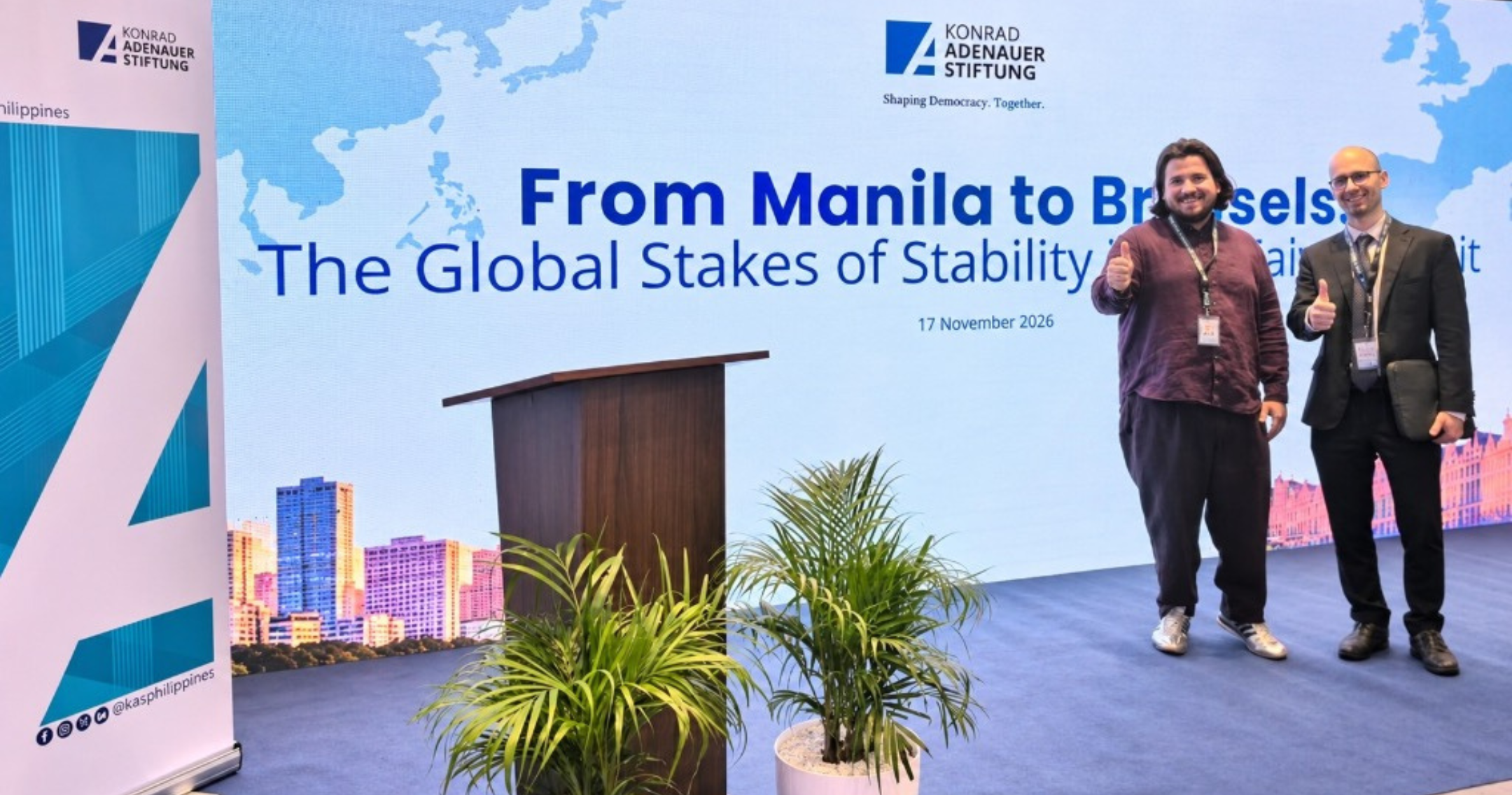
Photo: Analysts from EVC’s Prague headquarters and Taiwan Office contributed to the 2026 Manila Dialogue, held November 15–17 alongside the ASEAN Summit.
From November 15 to 17, 2026, analysts from the European Values Center for Security Policy in Prague and Taipei took part in the Manila Dialogue on the South China Sea. The Dialogue coincided with the 49th ASEAN Summit, hosted by the Philippines as ASEAN chair for 2026.
Convened by the WPS Foundation, the Manila Dialogue brings together policymakers, coast guard and defense officials, diplomats and experts from the region and beyond to advance a free, open and rules-based maritime order. This year’s edition came ten years after the 2016 arbitral award in Philippines v. China, which remains the cornerstone of the legal case against Beijing’s expansive claims. It was a fitting moment to take stock of what the award has achieved, and of how pressure in the South China Sea and the Taiwan Strait increasingly forms part of one regional picture.
Gray-zone pressure from the Baltic to the South China Sea
On November 17, Ondrej Malek, Analyst at EVC, spoke at the KAS Philippines Special Plenary Session for the 2026 Manila Dialogue, “From Maritime Militias to Shadow Fleets: Comparing Gray Zone Activities in the Indo-Pacific and Europe.” The session was chaired by Dr. Zsuzsa Anna Ferenczy of the Wilfried Martens Centre for European Studies. Malek spoke alongside Johannes Volkmann, Member of the German Bundestag (CDU); Dr. Collin Koh of the S. Rajaratnam School of International Studies; and Johannes Peters of the Institute for Security Policy at Kiel University.
The panel compared how China’s maritime militia in the South China Sea and Russia’s shadow fleet in the Baltic both operate below the threshold of armed conflict, testing coastal states’ resolve while avoiding a clear trigger for a response.
The global stakes of stability in the Taiwan Strait
On November 17, Marcin Jerzewski, Head of EVC’s Taiwan Office, spoke at “From Manila to Brussels: The Global Stakes of Stability in the Taiwan Strait,” a closed-door dinner discussion hosted by the Konrad-Adenauer-Stiftung Philippines. His brief was to set out the implications of a Taiwan contingency for Taiwan itself.
Hours before the session, Taiwan’s Ministry of National Defense reported that two Russian military aircraft had entered Taiwan’s air defense identification zone. It was the first time the ministry had publicly reported Russian aircraft in its ADIZ. Drawing on his work on two-theater contingencies, Jerzewski argued that Russia is a Pacific power in its own right and that its coordination with China now reaches the Taiwan Strait. He also warned that political polarization in Taiwan is one of the cheapest tools Beijing has for gaining control over Taiwan without firing a single bullet.
“Friends should be chosen wisely. In December 2023, under President Marcos Jr., two Russian Pacific Fleet warships made a scheduled port call here in Manila. This administration has been more careful overall. But every port call, every exercise, and every photo opportunity is a signal, and Beijing and Moscow read those signals as a pair,” Jerzewski said.
Closer than we think
EVC’s participation in the Manila Dialogue reflects the core of its mandate. China’s support for Russia’s war against Ukraine, Russian aircraft near Taiwan, and gray-zone pressure from the Baltic to the South China Sea all show that Europe’s security and the Indo-Pacific’s security can no longer be treated separately. Through its offices in Prague and Taipei, its crisis simulations, and its dialogue with partners across both regions, EVC brings European perspectives into Indo-Pacific debates and Indo-Pacific perspectives back to Europe.
Amplifying voices from Europe and the Indo-Pacific. Because we are closer than we think.
EVC thanks the WPS Foundation and KAS Philippines for the invitation and their hospitality.