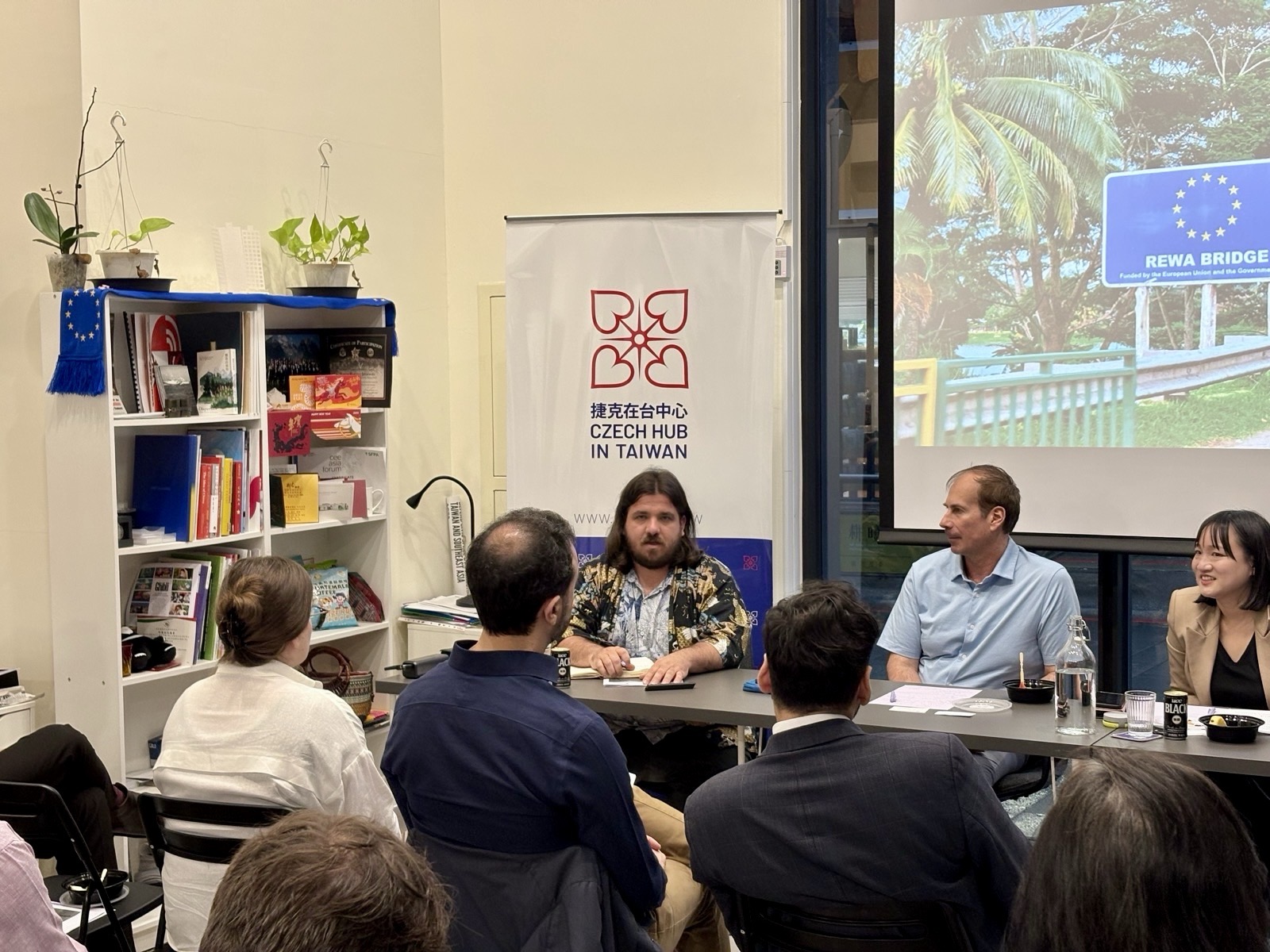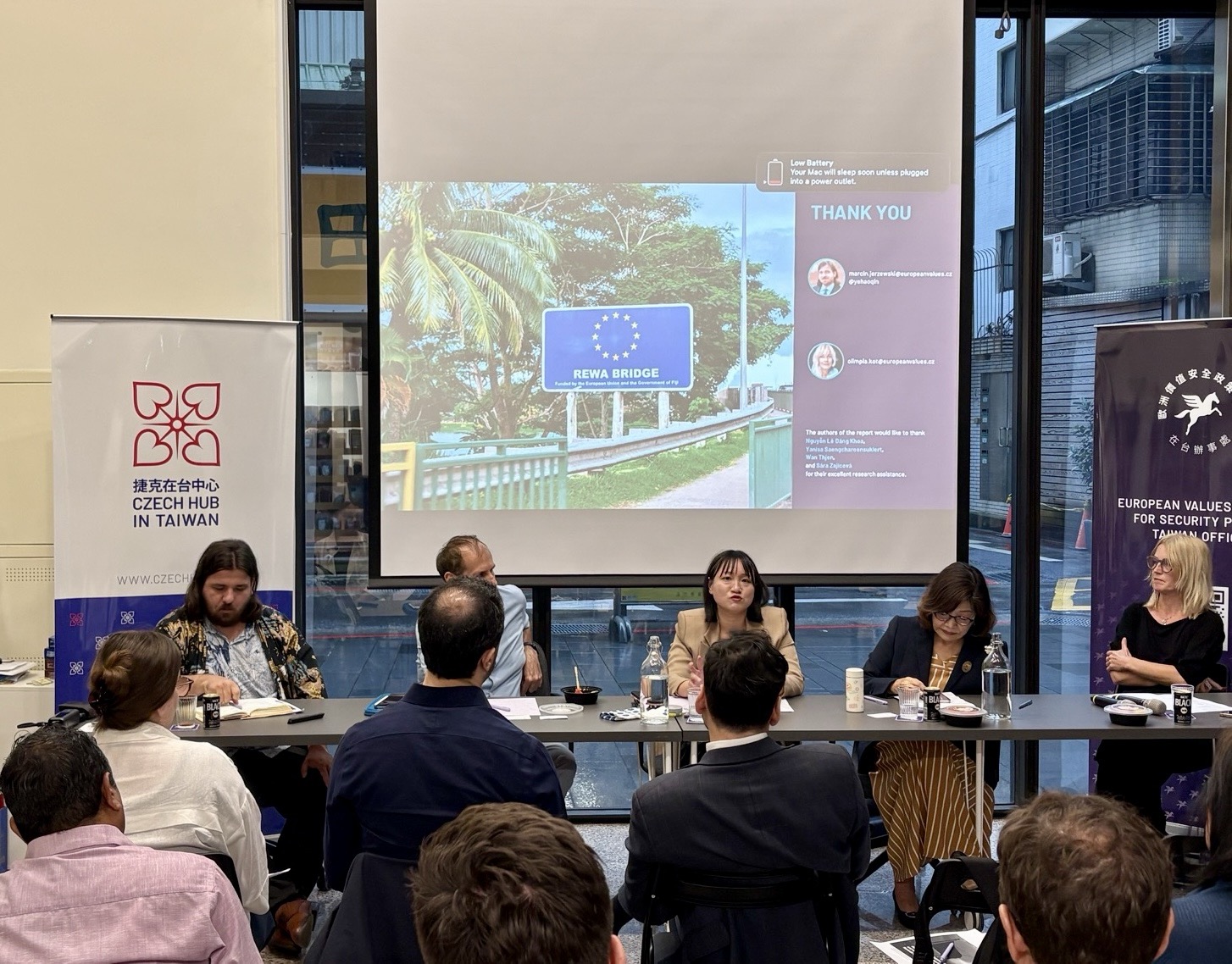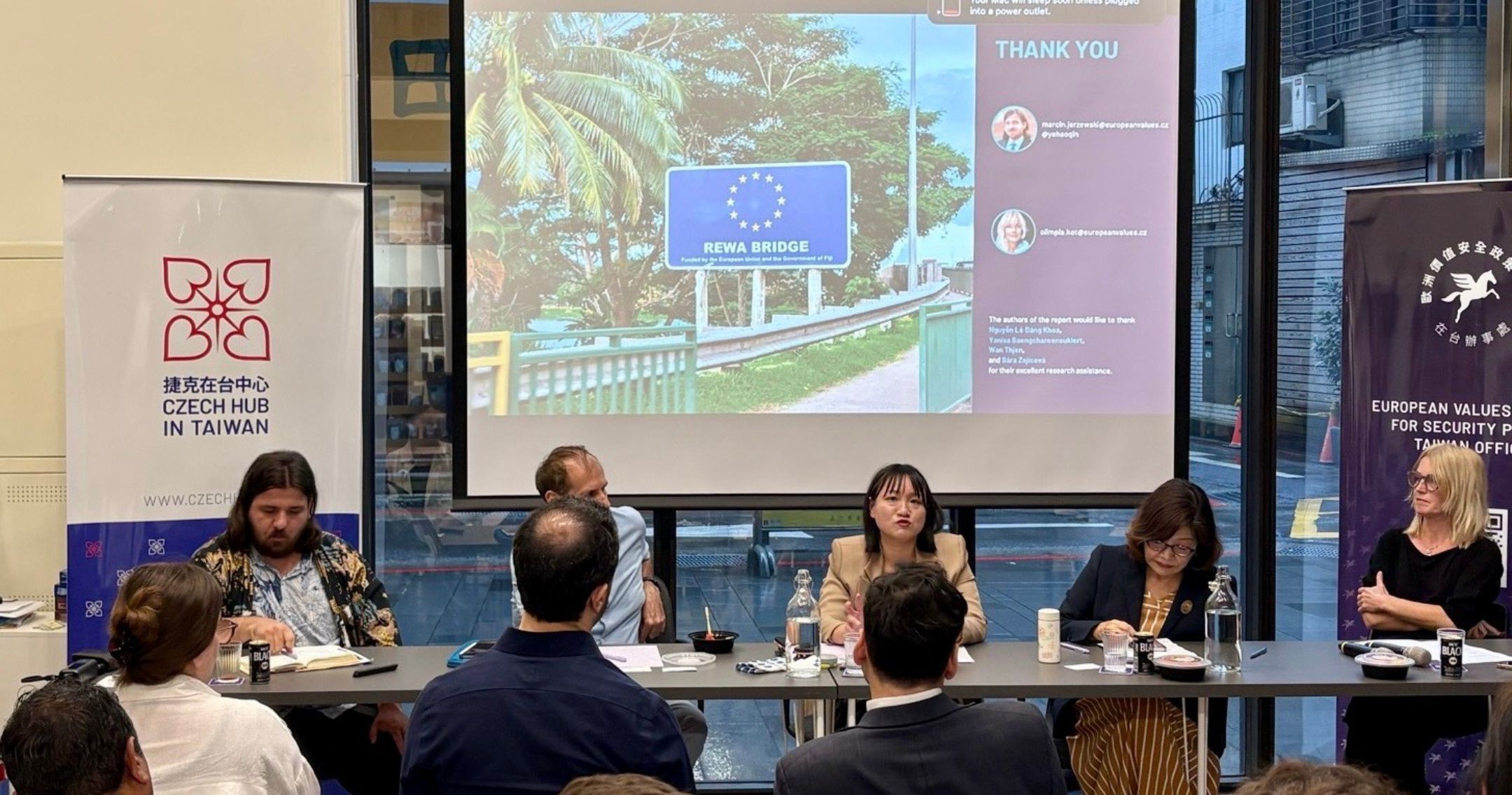
On May 5, 2026, the European Values Center for Security Policy (EVC) Taiwan Office organized a panel discussion examining opportunities for cooperation between the European Union’s Global Gateway (GG) Initiative and Taiwan’s New Southbound Policy (NSP). The discussion brought together experts and practitioners to explore how Taiwan and the EU can leverage their respective strengths to advance sustainable development and connectivity in the Indo-Pacific.
The panel featured Alfred Gerstl, President of the Central European Institute in Asian Studies (CEIAS); Kristy Hsu, Associate Research Fellow and Director at the Chung-Hua Institution for Economic Research (CIER); Peifen Hsieh, Deputy Secretary General of the International Cooperation and Development Fund (TaiwanICDF); and Marcin Jerzewski, Head of the EVC Taiwan Office.
The discussion highlighted Taiwan’s comparative advantages in areas such as healthcare, agriculture, and Electronic Design Automation (EDA), and considered how these capabilities could complement the implementation of Global Gateway projects. Participants pointed to TaiwanICDF’s ongoing development programs in Africa and Southeast Asia as examples of Taiwan’s practical experience and long-term engagement with partner countries.
Speakers noted that after more than a decade of implementing the New Southbound Policy, Taiwan has developed extensive networks across Southeast Asia through government initiatives, development cooperation, business engagement, and people-to-people exchanges. In many cases, Taiwanese businesses and civil society organizations have maintained a local presence for several generations, creating valuable expertise and trusted partnerships. For the European Union, cooperation with Taiwan could therefore provide access to established local networks while helping diversify and strengthen Global Gateway engagement in the Indo-Pacific.
Reflecting on the future of regional cooperation, Peifen Hsieh emphasized the importance of viewing development initiatives as complementary rather than competitive.
“Instead of being competitive, the landscape should be more compatible if we invite more players in this region. Rather than viewing the Indo-Pacific as a competitive arena for influence among major powers, inviting more like-minded players can foster compatibility and synergy.”
Participants agreed that cooperation between the EU and Taiwan could begin with informal and technical consultations focused on practical areas of mutual interest. They also highlighted the important role of non-governmental actors, including businesses, research institutions, and civil society organizations, in identifying opportunities for collaboration and ensuring that development initiatives respond to local needs.
The discussion concluded that closer coordination among the EU, Taiwan, and other like-minded partners could help avoid duplication of efforts, improve the effectiveness of development assistance, and contribute to a more resilient and interconnected Indo-Pacific region.
The event also reflected the EVC Taiwan Office’s ongoing efforts to connect experts, policymakers, and practitioners from Europe and the Indo-Pacific. By facilitating dialogue among like-minded stakeholders, EVC seeks to identify opportunities for practical cooperation, strengthen policy coordination, and contribute to a more resilient and connected democratic partnership network in the region.