

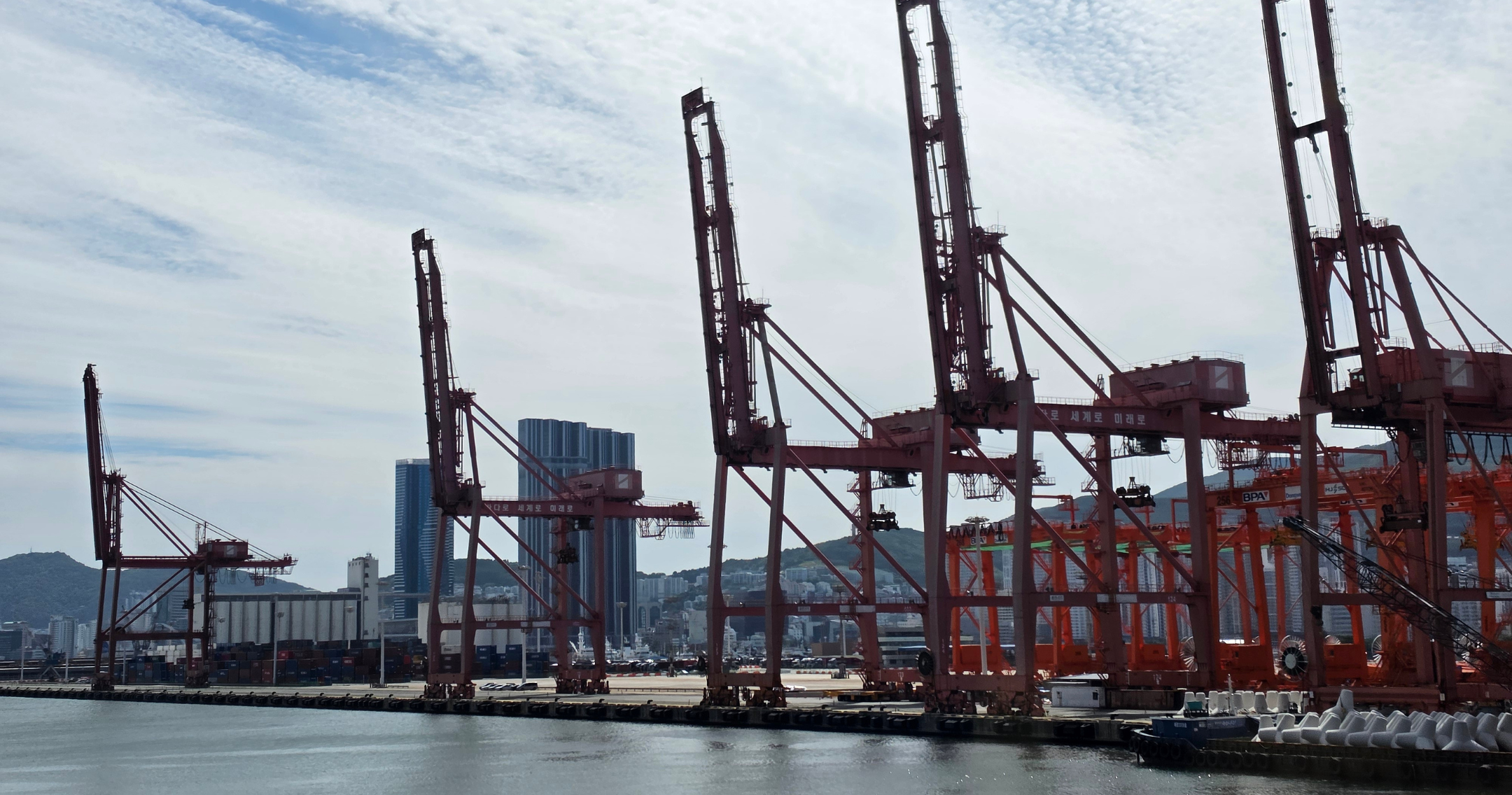
South Korea’s local elections were mostly read as a domestic political story: a test of South Korean President Lee Jae-myung’s governing momentum, a setback for conservatives outside Seoul and another sign of the country’s turbulent politics following the 2024 martial law crisis. Yet one result deserves closer attention in Taipei. The Democratic Party’s victory in Busan, South Korea’s second-largest city and its main maritime gateway, was not merely a partisan shift. It was a reminder that in maritime democracies, ocean policy is never only about ports.
Busan is not just a city. It is a logistics hub, a shipbuilding ecosystem, a political symbol, and a national security asset. Through Busan, South Korea connects its domestic industry with global shipping, port automation, naval planning and ocean governance.
This is why Busan’s new Democratic mayor, former oceans and fisheries minister Jeon Jae-soo, matters. His Arctic Gateway agenda is not a decorative local slogan, but a concrete development strategy for a city whose port, shipbuilding base, logistics companies and research institutions already make it central to South Korea’s maritime economy.
It also aligns with Lee’s central government priorities. Lee has pushed to relocate the Ministry of Oceans and Fisheries to Busan, while its leadership frames the city as a strategic base in the era of Arctic shipping routes. This positions Busan not only as South Korea’s main southern port, but also as a future gateway to northern routes. Melting ice caps open new transit links between East Asia and Europe, but also intensify geopolitical competition over infrastructure, standards, resources and presence. Taiwan should pay attention, as the Arctic is often seen in Taipei as distant and marginal to immediate security concerns, overshadowed by coercion in the Taiwan Strait, gray-zone pressure on outlying islands, energy import vulnerabilities, and the challenge of maintaining diplomatic space. Against this backdrop, Arctic policy can appear luxurious.
That view is understandable. It is also incomplete.
The Arctic is not merely a remote research theater. It is becoming a test of how maritime states prepare for climate change, shipping-route uncertainty, critical infrastructure vulnerabilities, supply chain realignment and the geopolitical expansion of authoritarian powers. Melting sea ice does not simply create new routes.
It creates new calculations for port authorities, shipping companies, insurers, satellite operators, naval planners and governments seeking influence in emerging governance spaces. For Taiwan, these calculations touch on the same questions that already define its security debate: who controls chokepoints, who sets standards and who can keep trade moving under pressure.
China understands this well. Beijing has described itself as a “near-Arctic state” and tied Arctic shipping to the Belt and Road Initiative through the language of the Polar Silk Road. This framing is designed to normalize China’s role in a region where it has no territorial sovereignty, while presenting connectivity as a benign substitute for power projection.
Taiwan should not respond by imitating Beijing’s inflated geography. Taiwan is not near the Arctic. It does not need to pretend otherwise. The point is not to produce a Taiwanese version of the Polar Silk Road, or to claim strategic centrality in every emerging theater. Responsible polar engagement requires the opposite: Precision.
Distance is not equal to irrelevance. Taiwan is one of the world’s most trade-dependent economies. Its prosperity rests on maritime connectivity, energy imports, port resilience and the uninterrupted movement of high-value goods. A country whose survival depends on the sea cannot afford to be indifferent to changes in global maritime geography.
South Korea offers a useful comparison because its polar ambitions are not built on slogans alone. They rest on institutions and hardware: the Korea Polar Research Institute, the Dasan Arctic research station in Svalbard, the icebreaking research vessel Araon, and the Ministry of Oceans and Fisheries, which treats polar activity as part of recurring national planning.
South Korea’s approach is not simply to plant a flag in the snow. It is to build an ecosystem linking science, industry, logistics and diplomacy.
Taiwan’s starting point is more modest, but not empty. The establishment of Taiwan’s first polar research station in Svalbard, through cooperation among National Central University, the National Academy of Marine Research and Polish partners, demonstrates that Taiwan already has a foothold. What it lacks is a broader policy framework that connects this scientific presence to maritime resilience, democratic cooperation and economic security.
That frame should begin with a modest but serious polar strategy. The Ocean Affairs Council, the National Academy of Marine Research, National Central University, the Ministry of Foreign Affairs and the Ministry of Economic Affairs should jointly identify where Taiwan can contribute to polar science, maritime monitoring and supply chain resilience. The goal should not be to compete with Arctic states, but to become useful to them and to other maritime democracies.
South Korea could be one of Taiwan’s first partners. A Taiwan-South Korea Maritime and Polar Resilience Dialogue could connect Keelung and Busan, as well as research institutes, port authorities, shipping companies and technology firms. The agenda should be concrete: ocean data, smart ports, low-carbon shipping, satellite applications, maritime cybersecurity, emergency logistics and the implications of Arctic route changes for Indo-Pacific supply chains.
Over time, this dialogue could be expanded to include partners such as Japan, Canada, Poland and Nordic partners. Such cooperation would also sharpen Taiwan’s foreign policy message.
Taiwan’s international space is constrained, but not closed. It can still be useful where democracies need trusted partners, technical expertise and non-authoritarian alternatives.
Taiwan does not need a Polar Silk Road. It needs democratic maritime literacy. In the coming century, that might prove just as strategic.
Author:
- Marcin Jerzewski 葉皓勤 is head of the Taiwan office of the European Values Center for Security Policy and a fellow at Visegrad Insight.
This article was originally published in Taipei Times.