


Photo: Taipei City Police Department patrol scooters, by Olimpia Kot
Taiwan’s exclusion from Interpol, alongside other international organizations, presents a persistent challenge to international law enforcement efforts. Not having access to Interpol’s policing infrastructure means that Taiwan is unable to rely on resources like criminal intelligence sharing and analysis, access to databases on criminal suspects and stolen property (including passports) and use the well-known Red Notice mechanism to secure arrests of suspects with a view to extraditing them to face criminal proceedings in Taiwan.
This is particularly worrisome given Taiwan’s position in global trade and logistics networks. Taiwanese ports are an important node in Indo-Pacific shipping lanes, connecting Taiwan’s vital industries with the rest of the world. However, as with anywhere else, the logistics sector attracts criminal activity — for example, drug trafficking or the smuggling of goods in order to circumvent export control measures, such as those aimed at preventing China’s access to AI chips.
Taiwan builds its own legal cooperation network
Combating organized transnational crime requires an organized transnational response. Barred from using formal Interpol mechanisms, Taiwan must rely on bilateral contacts through which it builds its own legal cooperation network.
The majority of Taiwan’s bilateral contacts with external partners in the field of criminal justice can be categorized as informal experience sharing. These activities are mostly focused on key partners such as the U.S., Australia, or the EU and its member states.
For instance, in 2023, Taiwanese Justice Minister Tsai Ching-hsiang (蔡清祥) met with officials from the EU Agency for Criminal Justice Cooperation (Eurojust) — the bloc’s equivalent to Interpol — to spur closer cooperation on judicial matters and combating crime.
While criminal justice is considered a shared competence in the EU system, the bulk of the responsibility lies with member states. Thus, besides engaging Eurojust, engaging member state officials is a crucial element of Taiwan’s efforts to build a robust partnership network.
As recently as May 2026, officials from Estonia, France, Germany, and Poland participated in the International Conference on Strengthening Cross-border Cooperation in Transnational Crime, which was held in Taipei.
In March 2025, a delegation led by head of Germany’s Bamberg High Prosecutors Office, Wolfgang Grundler, visited Taiwan to gain insight into the country’s guidelines on combating fraud and the investigation of trade secrets crimes in the high-tech sector.
Three years earlier, in March 2022, Slovakia co-organized with Taiwan, Australia, Japan, and the U.S. a virtual workshop on combating digital crimes. Nearly 300 law enforcement officials from 32 countries took part in the initiative, which focused on best practices to counter cyber financial crimes.
Formal judicial cooperation and legal assistance still not the norm
While valuable, these engagements offer only a partial fix, as they do not constitute formal pathways for judicial cooperation and other forms of mutual legal assistance. Due to Taiwan’s lack of diplomatic recognition, and pressure from the People’s Republic of China (PRC) to eschew official engagements with Taiwan, only a handful of states have signed international treaties with Taipei on judicial cooperation, legal assistance, and extraditions.
In Europe, six states have entered into formal arrangements with Taiwan: Denmark, Germany, Poland, Slovakia, Switzerland, and the UK. In case of the treaties with the UK (concluded in 2016), Denmark (2019), and Switzerland (2020), the deals are focused on transfers of sentenced persons. Taiwan has similar agreements in place also with other key partners, like the U.S. (its main security guarantor) or Paraguay (one of the few states officially recognizing Taiwan).
Only the agreements with Poland (2019), Slovakia (2021), and Germany (originally signed in 2012, expanded in 2023) can be considered relatively comprehensive deals. These treaties deal with a broader range of topics, including transfers of sentenced persons, provisional arrests, legal assistance (such as the serving of documents and taking of evidence, etc.), or formalized information sharing pathways. In the case of Poland and Slovakia, the treaties also includes extradition provisions.
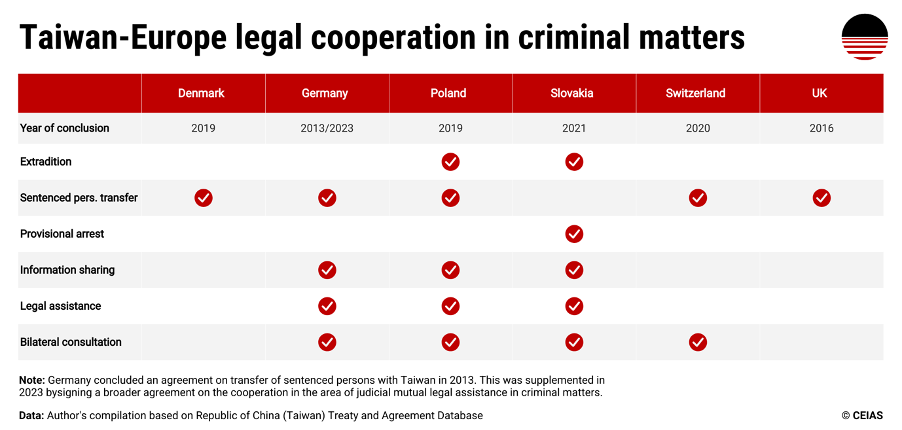
Photo: Taiwan-Europe legal cooperation in criminal matters, source: CEIAS
Whether any country agrees to including an extradition element to their legal cooperation with Taiwan is noteworthy for three reasons:
- Criminal jurisdiction is deeply tied to a state’s monopoly on violence — a prerogative to lawful use of force on its territory — and thus its sovereignty. By agreeing to an extradition, a state gives up its judicial sovereignty in favor of another state. Extradition agreements with Taiwan therefore carry symbolic weight, as they imply de facto recognition of Taiwan’s statehood and expand its international space.
- Extradition is both a legal and political process. It typically requires consent from both the judiciary (as a court assesses the legal permissibility of an extradition) and executive authorities (as the minister of justice makes a political decision to carry out an extradition). While extraditions can proceed without a corresponding international agreement in place, purely based on domestic laws, a lack of treaty turns extraditions into a less predictable and potentially more politically arbitrary process. By signing an extradition treaty, the executive signals to the judiciary that it considers the other party a reliable partner with whom extraditions are expected to proceed in a smooth and predictable manner.
- In case of Taiwan, an extradition treaty can offer an extra layer of protection to Taiwanese citizens against surrendering them to the PRC. In 2017, PRC requested to extradite a Taiwanese national, Liu Hung-tao (劉鴻濤), from Poland on grounds of suspected commitment of telecom fraud. While Warsaw initially consented, the European Court of Human Rights later overruled the extradition over fears that Liu would be subjected to torture, or to inhumane or degrading treatment or punishment. Following the implementation of the Taiwan-Poland agreement, Liu was extradited to Taiwan instead for further criminal proceedings.
Way forward
As bilateral legal cooperation helps Taiwan to overcome, at least partially, its exclusion from Interpol, as well as to achieve goals of expanding its international space and shielding its nationals from extraditions to the PRC, broadening such collaboration should be among Taipei’s top priorities.
In Europe, countries that are already open to engaging Taiwan beyond economic cooperation would be natural candidates for this type of cooperation: France, Czechia, and Lithuania are among the most open partners of Taiwan in Europe, yet none of the have a criminal legal cooperation mechanism in place with Taiwan. Other prospective candidates would be the Netherlands (cooperation is crucial for enforcing semiconductors exports control and related prosecution of evasion attempts), Estonia and Romania (both of which recently signaled openness to broader engagements with Taiwan), or Belgium (which recently successfully carried out ad hoc evidence-taking cooperation with Taiwan in a drugs case).
To improve the odds of this agenda being taken on by Europeans, Taiwan needs to better signal that it subscribes to same rule-of-law standards. Working with European states on achieving membership of the International Criminal Court would be one example of a relatively low hanging fruit. Adopting a moratorium on the use of death penalty — which the EU repeatedly voices concerns about — while pursuing a path towards full abolition, would be an even stronger signal of normative convergence, albeit domestically unpopular.
Matej Šimalčík
Matej Šimalčík, Executive Director, Central European Institute of Asian Studies (CEIAS). His research focuses on China’s economic and political influence in Central Europe, elite relations, corrosive capital, and the role of European legal instruments in mitigating risks posed by China. He has a background in Law and International Relations and was listed in the Forbes 30 Under 30 (Slovak edition) in 2021. He is also a member of the Expert Pool at the European Center of Excellence for Countering Hybrid Threats (Hybrid CoE), and the European Think-tank Network on China. In 2025, he became a visiting fellow at the Institute of National Defense and Security Research (INDSR) in Taipei under the Taiwan Fellowship program.