

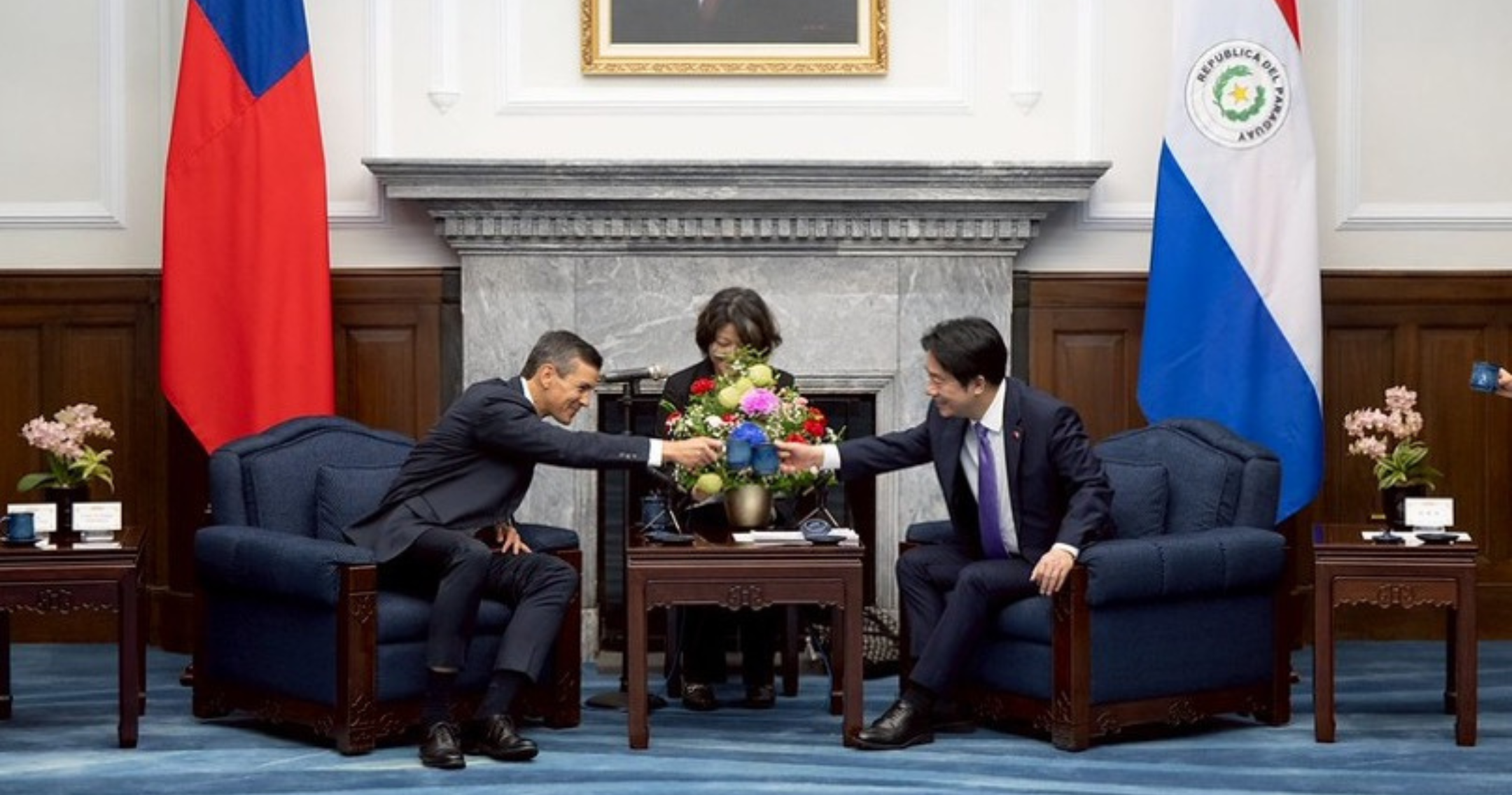
Photo: President Lai Ching-te meets President Santiago Peña. Source: Office of the President
What’s happening?
On his fourth visit to Taiwan, Paraguayan President Santiago Peña announced a joint “50-50” partnership with Taiwan to develop one of the world’s largest AI data center projects in Paraguay. The project will be developed under a binational entity named “Yguazú Digitall” and is framed as the world’s first government-to-government plan to jointly build AI computing facilities. According to the proposal, the center will help Paraguay develop its AI industry and meet rising global demand for computing power and clean energy. The agreement proposes a “Digital Data Embassy” that would give the AI data center’s servers and data Yguazú Digital protections to secure and safeguard the information. The project can be understood as part of Peña government’s “Digital Transformation” project which aims to turn Paraguay into a regional technology hub.
What’s the broader picture?
Through this project, Taiwan is expanding its integrated diplomacy by leveraging national strengths in technology and digital innovation. Taiwan frames this as a flagship example of sustainable development, as it will be powered by Paraguay’s surplus hydroelectric energy.
The integrated diplomacy approach envisioned by President Lai Ching-te (賴清德), which aims to realize values-based diplomacy and transform Taiwan into a thriving global economic powerhouse, mirrors Paraguay’s Digital Transformation initiative.
Of course, this is not the first project Taiwan has collaborated on in Paraguay. The Health Information System (HIS), developed jointly by the International Cooperation and Development Fund (TaiwanICDF) and Paraguayan partners, is now in use in more than 1000 public healthcare facilities across the country. The success of this program may have given Taiwan the confidence to initiate and expand projects of this scale in the country.
This ambitious project can also be considered part of Taiwan’s new diplomatic vision under the so-called Double-12 structure. The Double-12 (總合外交雙12) in Taiwan is a way of organizing integrated diplomacy proposed by Foreign Minister Lin Chia-lung. The first 12 refer to key foreign policy directions, such as strengthening ties with its official diplomatic allies, expanding participation in international organizations, and promoting regional security and economic cooperation. The second 12 focus on like-minded countries and practical areas of implementation. The project’s emphasis on sovereign AI aligns closely with these broader diplomatic and technological objectives.
Needless to say the project is not without detractors, some of whom have raised concerns about Paraguay compromising its energy sovereignty. Several Paraguayan experts have also questioned whether the country possesses the human capital necessary to benefit from such an advanced technological investment. Members of Paraguay’s AI sector have warned that the project risks becoming disconnected from local realities because Paraguay currently lacks enough trained engineers, researchers, and AI specialists to support an ecosystem of innovation around the infrastructure. Instead of creating a broad-based knowledge economy, the project could depend heavily on foreign expertise and imported labor.
Nonetheless, from Taiwan’s perspective, the significance of this project cannot be overstated. It represents not only a political and economic partnership, but also an opportunity to deepen Taiwan’s presence in South America through its only diplomatic ally in the region. In doing so, Taiwan seeks to position itself as a leader in green digital infrastructure.
Why does it matter?
The proposal is compelling: Taiwan’s technological expertise would be combined with Paraguay’s clean energy resources to create an alternative model for AI infrastructure development. In theory, the project aligns with and advances both countries’ strategic visions for AI development. If successful, it could reinforce Taiwan’s image as a promoter of sustainable AI infrastructure and serve as a model that could be replicated elsewhere.
As a result, the project may serve as a litmus test for Taiwan’s broader ambitions in AI diplomacy and digital infrastructure development, demonstrating whether large-scale technology partnerships can translate diplomatic vision into sustainable local outcomes that extend beyond the label of “green infrastructure.” Ultimately, its success will depend on whether the necessary legal framework, social sustainability considerations, and local development objectives are integrated throughout the implementation process. Only then can the project achieve both environmental and broader societal sustainability goals.