

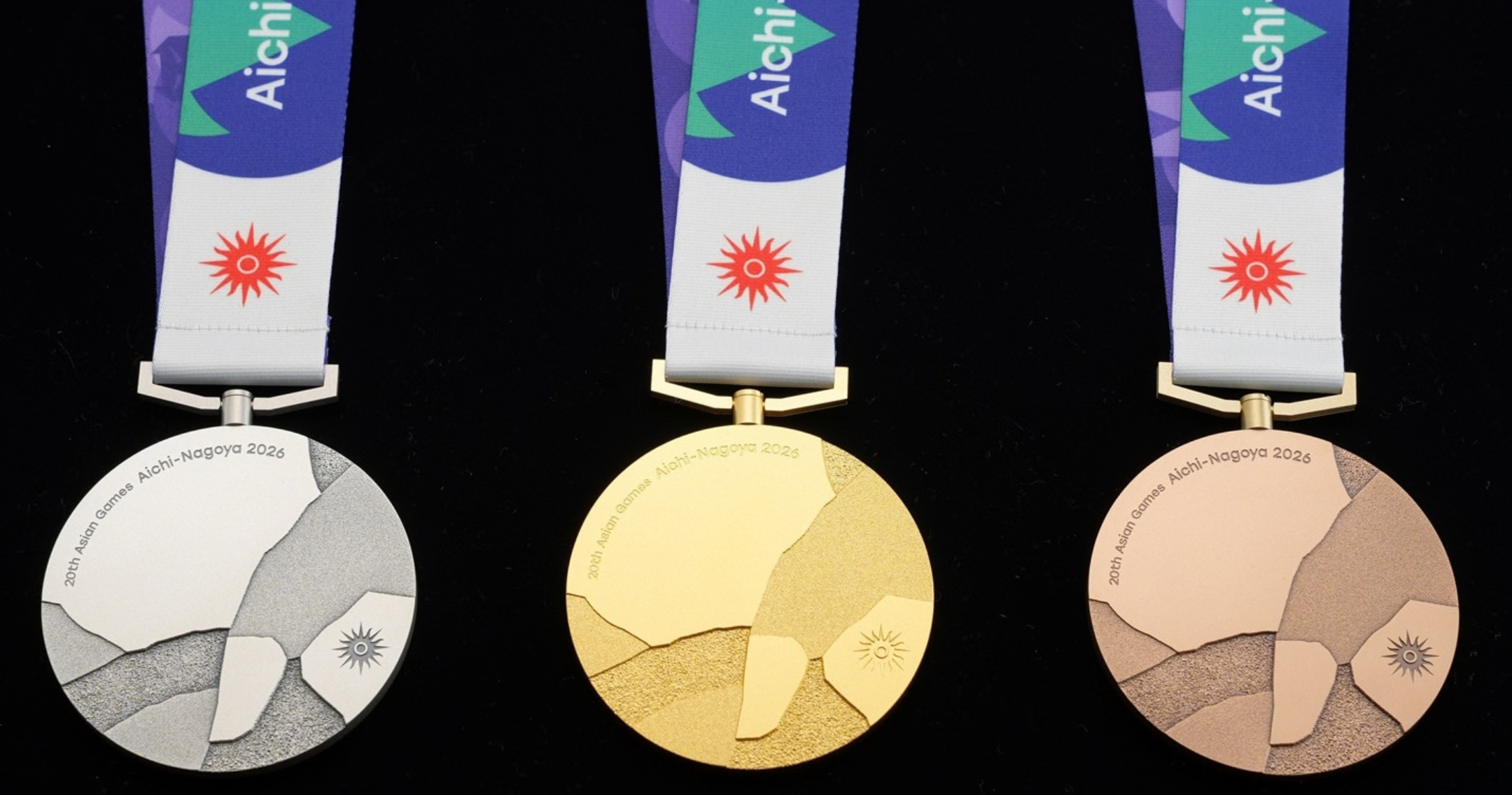
Photo: Medals of 2026 Asian Games. Source: 20th Asian Games Aichi-Nagoya 2026.
What is happening?
The 2026 Asian Games in Japan wrapped up October 4, concluding a 16-day tournament that took place in Aichi-Nagoya and brought together more than 17,000 athletes and officials from 45 countries and regions. In terms of participation, this made the event even bigger than the 2024 Paris Olympics. Alongside familiar Olympic disciplines, spectators could also enjoy traditional Asian sports, including sepak takraw, kabaddi and wushu.
Beyond the sporting competition, however, the Games took place against a backdrop of diplomatic and geopolitical tensions. This article looks at several of these episodes, with focus on a narrow selection of East Asian delegations.
What is the broader picture?
First held in New Delhi in 1951, the Asian Games are an important sporting event across the continent. Their stated purpose extends beyond competition, with the Olympic Council of Asia (OCA) presenting the Games as a means of promoting friendship, solidarity and peace among Asian nations.
For Japan, which has participated in the event from its inception, the Games became a major platform for re-establishing a place in the international community in the post-WWII era. Tokyo subsequently hosted the Asian Games in 1958, followed by the 1964 Olympics, which projected a new Japanese identity as a modern, peaceful and technologically advanced country. Hosting the Asian Games for a third time therefore carries a significance that goes beyond sport, as Japan once more positions itself at the center of a major pan-Asian gathering.
Nevertheless, while sport is often presented as apolitical, the Games’ claim to political neutrality is difficult to sustain. Hong Kong and Macau compete as separate delegations from China, but their participation is ultimately subject to Beijing’s approval. Meanwhile, the case of Taiwan makes the instrumentalization of the Games even more apparent as the self-governing democracy was forced to compete under the name “Chinese Taipei”. Rather than representing a satisfactory compromise, as is often argued, this situation reflects the stifling diplomatic pressure applied by Beijing, which aims to systematically undermine Taiwan’s de facto independence on an international stage. Compounding this tension, Taiwan’s Sports Minister Lee Yang (李洋) was initially prevented from attending a pre-Games welcome ceremony at which national flags – or, in Taiwan’s case, the Chinese Taipei Olympic Flag – were raised. The debacle, which apparently stemmed from an OCA order to exclude the Taiwanese official, delayed the ceremony for about an hour before Lee, a back-to-back Olympic badminton doubles champion in 2024 and 2020, was ultimately allowed to participate.
Geopolitically, the event allows powerful nations to suppress rivals diplomatically while simultaneously leveraging the stage to projecting their own national strength. This is particularly evident in the case of the People’s Republic of China (PRC), which dominated the medal table, winning 169 of the 469 gold medals available. Typically, Chinese state media explicitly link this tally with the narrative of “China’s rise,” framing the country’s sporting success as a reflection of its wider emergence on the international stage in accordance with PRC talking points. Victories are framed in national terms, with athletes viewing their gold medals as the ultimate means of bringing China glory.
Another country touting its achievements at the Games will be North Korea, which brought home new world records and seven gold medals in weightlifting. For Pyongyang, the Asian Games provide a rare international stage on which its athletes can fly the national flag and generate prestige for the country – accomplishment that can subsequently be presented to a domestic audience as evidence of national success. International sport remains one of North Korea’s relatively few windows for maintaining contact with the outside world, and its presence in Japan is especially significant as Tokyo made a strict, one-off sports exception to its entry ban on North Korean nationals. The restriction was imposed in 2016, based on Pyongyang’s ongoing nuclear and ballistic-missile programmes.
Why does it matter?
International tournaments may present themselves as spaces where sport stands above politics, but in reality, these platforms are inevitably used to project political messages, national identity and power. Questions of sovereignty, recognition and diplomatic pressure extend even into ceremonies and team designations. At the same time, every medal becomes more than a sporting achievement: It can be turned into a display of national strength, prestige and soft power. In Asia, as much as anywhere else, the scoreboard is political, too.