

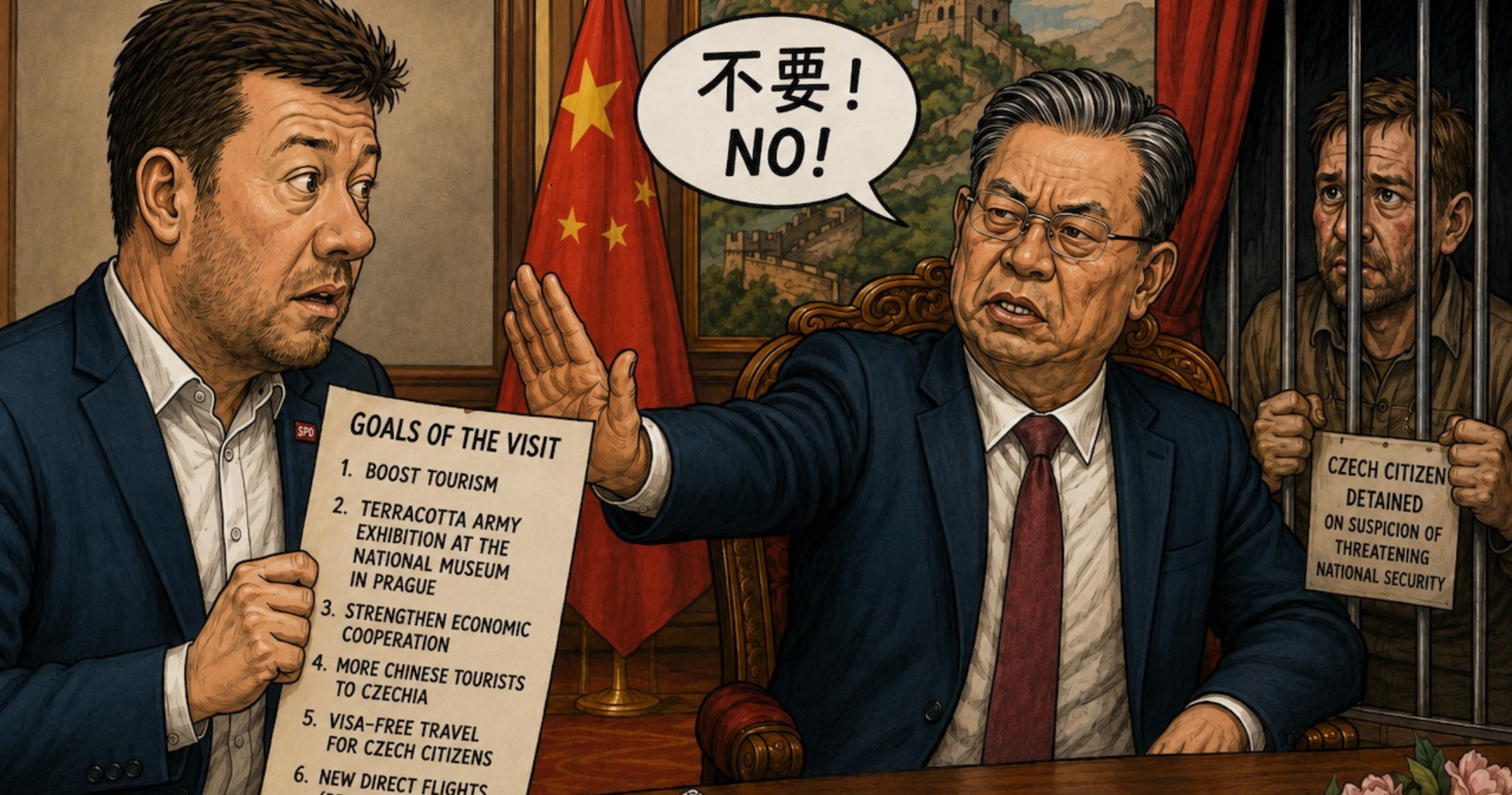
Photo: AI generated
What is happening?
When the Speaker of the Czech Chamber of Deputies visited China, his original intention was to discuss trade re-engagement and the revival of tourism. Instead, Tomio Okamura, of the Freedom and Direct Democracy party (SPD), was confronted with a complex consular crisis: the retaliatory detention of a Czech citizen in China just days before his arrival.
What is the broader picture?
Tomio Okamura — speaker of the Czech Parliament, chairman of the right-wing SPD, and former president of the Association of Czech Travel Agencies — traveled to China with an agenda focused heavily on the travel industry. His goal was to warm bilateral relations, which have remained cold since former China-friendly President Miloš Zeman left office — especially given that almost none of the promised Chinese investments materialized during Zeman’s tenure.
Okamura’s priorities included: increasing the number of Chinese tourists visiting Czechia, which plummeted during the COVID-19 pandemic and has yet to return to pre-pandemic levels; securing visa-free travel for Czech tourists, as Czechia remains one of the few EU member states without a visa waiver from Beijing; adding new direct flights beyond the current Prague-Beijing connection; fostering commercial ties alongside a business delegation organized by the Confederation of Industry of the Czech Republic; and securing a Terracotta Army exhibition for the National Museum in Prague.
However, Okamura’s plans were disrupted by the late-June detention of a Czech national in China on charges of threatening national security. According to Czech media, the individual had been invited to China to perform technical service work on airport radar systems and was contracted by Eldis, a subsidiary of Czechoslovak Group (CSG), a major Czech defense conglomerate.
On July 16, Chinese Foreign Ministry spokesperson Lin Jian (林剑) confirmed the Czech citizen’s detention on suspicion of national security crimes. Simultaneously, he condemned the detention of a Chinese national in Czechia, stating, “China firmly opposes this action. We urge the Czech side to immediately release the relevant personnel and effectively safeguard their legitimate rights and interests.”
The Chinese national in question, Yang Yiming (杨艺明), was detained in Czechia earlier this year on charges of unauthorized activity for a foreign power and is currently awaiting a decision from the Czech judicial system.
The Czech delegation raised the detainee’s case during bilateral meetings. Deputy Foreign Minister Jiří Brodský, who participated in the negotiations, reported that when asked to release the Czech citizen, Chinese officials countered that “they have their own issue” — a direct reference to Yang.
This marks the first time China has employed “hostage diplomacy” against Czechia. Perhaps the best-known example of such tactics is the 2018 “Two Michaels” case. This involved the detention of Canadian citizens Michael Kovrig and Michael Spavor for over 1,000 days in retaliation for Canada’s arrest of Meng Wanzhou (孟晚舟), chief financial officer of Chinese communications giant Huawei, on a U.S. extradition warrant.
Why does it matter?
Despite clear signs of hostage diplomacy, the Czech Ministry of Foreign Affairs has publicly resisted linking the two cases and has notably failed to issue an updated travel warning for Czech citizens traveling to China. In this context, negotiations regarding visa waivers and tourism expansion appear disconnected from geopolitical realities.
Czechia has previously learned that Beijing’s diplomatic promises often diverge from its actions. On the one hand Okamura was promised direct Prague-Shanghai flights. National People’s Congress Chairman Zhao Leji (赵乐际) also stated that “more Czech representatives are welcome to visit China.” On the other hand, before the delegation even left Beijing, on July 24, Czech vehicle manufacturer Tatra Trucks was placed on an export sanctions list on Friday.
While Okamura promotes deeper tourism, trade, and people-to-people exchanges, the detention of a Czech citizen in China on national security grounds significantly elevates political and legal risks for Czech citizens and firms operating in China. This contradiction raises serious questions about whether the conditions for genuinely improving bilateral relations currently exist.