

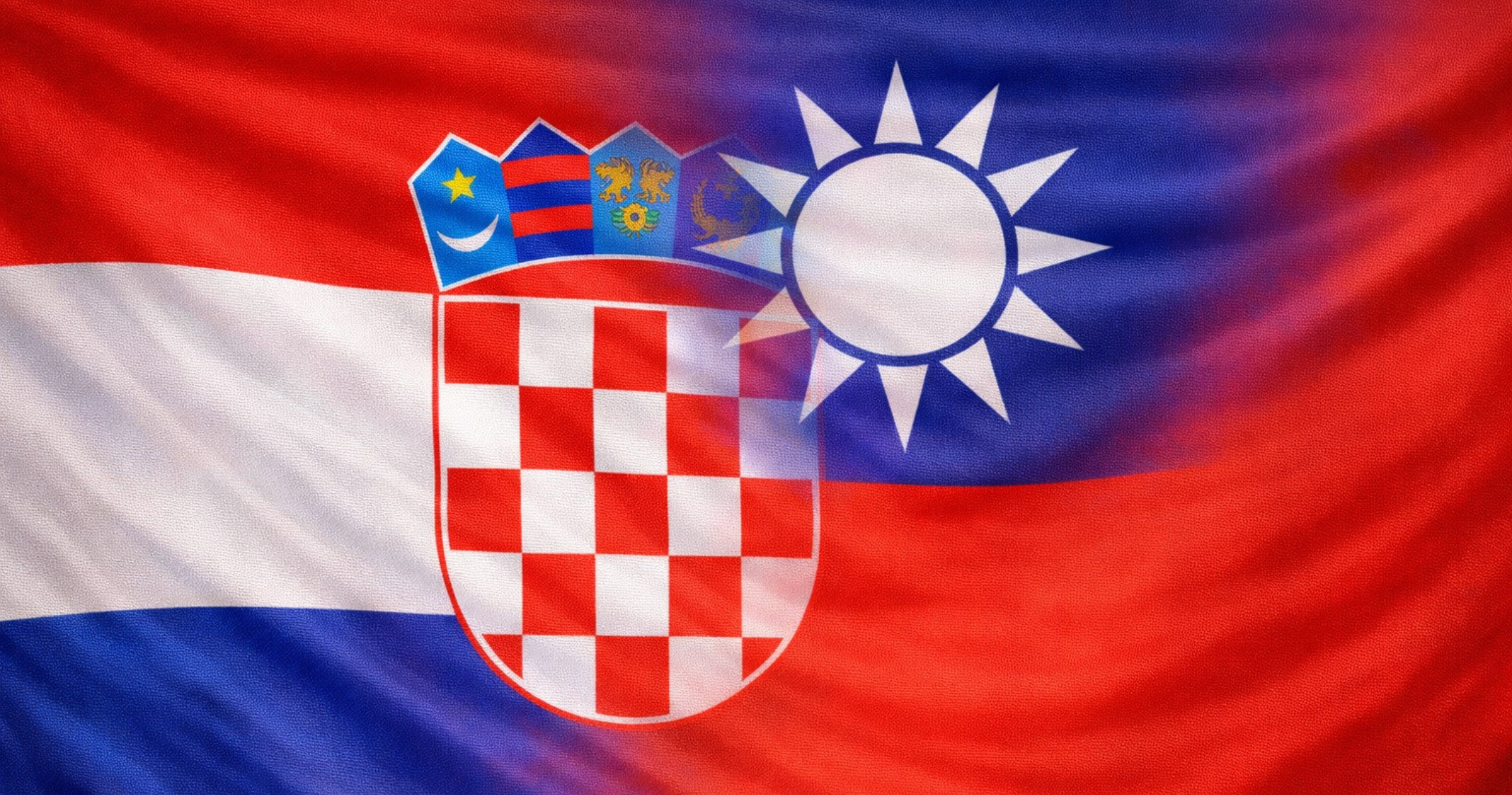
Photo: Canva.com
What is happening?
Croatia and Taiwan, while geographically distant and politically disconnected, possess significant untapped potential for bilateral cooperation. While Croatia’s zero-sum relationship with the People’s Republic of China (PRC) leaves Taiwan diplomatically sidelined, shifting global dynamics and emerging industries present new opportunities for engagement beyond official politics. By focusing on practical and mutually beneficial initiatives, Croatia and Taiwan can develop substantial relationships that sidestep official diplomatic hurdles.
What is the broader picture?
Zagreb and Taipei have never meaningfully engaged at the political level. The Croatian government’s emphasis on maintaining positive relations with the PRC remains the primary obstacle preventing officials from interacting with their Taiwanese counterparts. Although Croatia is less economically dependent on the PRC than some other European Union (EU) countries (with trade volume reaching EUR 148 million in 2025), it has adhered to Beijing’s version of the “One China Principle” since 2008.
Additionally, Croatia’s participation in the 16(14)+1 framework and the Belt and Road Initiative (BRI) reinforces a cross-party consensus in favor of a zero-sum relationship with the PRC, leaving little room for engagement with Taiwan.
Therefore, the most promising avenues for cooperation lie in private-to-private engagement—particularly in the drone industry.
One of Croatia’s leading drone companies, Orqa, is engaging with Taiwanese partners to support the development of a non-Chinese UAV supply chain. Orqa specializes in First Person View (FPV) drones, UAV systems, and communication systems. Last year, they launched a Global Manufacturing Partnership Program, enabling them to collaborate with global manufacturing partners to increase production capacity to one million drones. Orqa already sells to over 50 countries worldwide, including Taiwan. A Taiwanese venture capital firm, Taiwania Capital, has this year participated in raising 12.7 million euros to support Orqa’s further development and innovation.
In light of reports that Serbia—Croatia’s primary security concern—purchased Chinese CM-400AKG hypersonic missiles last year amid broader militarization efforts supported by China, Croatia could use this opportunity to deepen defense industrial cooperation with Taiwan. As the EU and Taiwan ramp up drone cooperation, Croatian drone companies can use this opportunity to increase their production capacity, innovation capabilities, and market share through trusted, resilient supply chain networks.
People-to-people relations encompass cooperation in academia, tourism, cultural exchange, language, and civil society engagement. At present, these areas remain underdeveloped but are sufficiently non-sensitive to avoid serious opposition from China. Croatians know little about Taiwan and its history, and vice versa. Despite analogous characteristics and geopolitical challenges, Croatia and Taiwan remain like-minded partners who have yet to fully realize the potential of their cooperation. The University of Zagreb is the only university in Croatia to offer a class on East Asian Security in partnership with the Taipei Economic and Cultural Office in Vienna (which covers Croatia), and is among the few institutions offering opportunities for student exchange and Mandarin language study in Taiwan. However, through this inceptive academic exchange, much more can be cultivated. Taiwan’s technological edge in semiconductors, manufacturing, AI, and overall technological innovation provides immense opportunities for Croatia to foster normative collaboration with trusted partners in these sensitive fields.
The tourism sector represents another viable cooperation prospect. With Croatia’s tourism industry accounting for up to 25 percent of total GDP (including indirect contributions), and Taiwanese tourism to Europe increasing by 23.09 percent in 2025, Croatia can capitalize on growing interest by strengthening its outreach and presence in Taiwan. Joint promotional campaigns, cultural exchanges, and the development of tailored travel packages could further stimulate Taiwanese arrivals. Strengthening tourism ties would not only boost economic gains but also foster deeper people-to-people connections between Croatia and Taiwan.
Why is it important?
Although political engagement between Croatia and Taiwan remains unlikely due to Croatia’s prioritization of relations with the PRC, alternative avenues for cooperation are steadily gaining momentum. Private-sector partnerships, academic collaboration, and tourism initiatives offer viable pathways to deepen bilateral relations. Equally important is the potential for defense cooperation, particularly in drone technology, which can strengthen both countries’ security and help create resilient, trusted supply chains. By strengthening private and institutional ties, both countries can unlock new opportunities for innovation, trade, and people-to-people exchange.
Lana Pedisić
Lana holds a Master’s in Global Security and Strategy from the Brussels School of Governance and a Bachelor’s in International Business from the Rochester Institute of Technology. Previously she has published on the Belt and Road Initiative in Europe, the Global Gateway and the Strategic Compass, and Serbia’s EU Candidacy for the Defence Horizon Journal. Lana also works as a Research Fellow at EuropaNova Germany. She is passionate about international and security affairs, focusing on European Foreign and Security Policy, Global Gateway, Belt and Road Initiative, EU-China, and EU-Taiwan relations.