

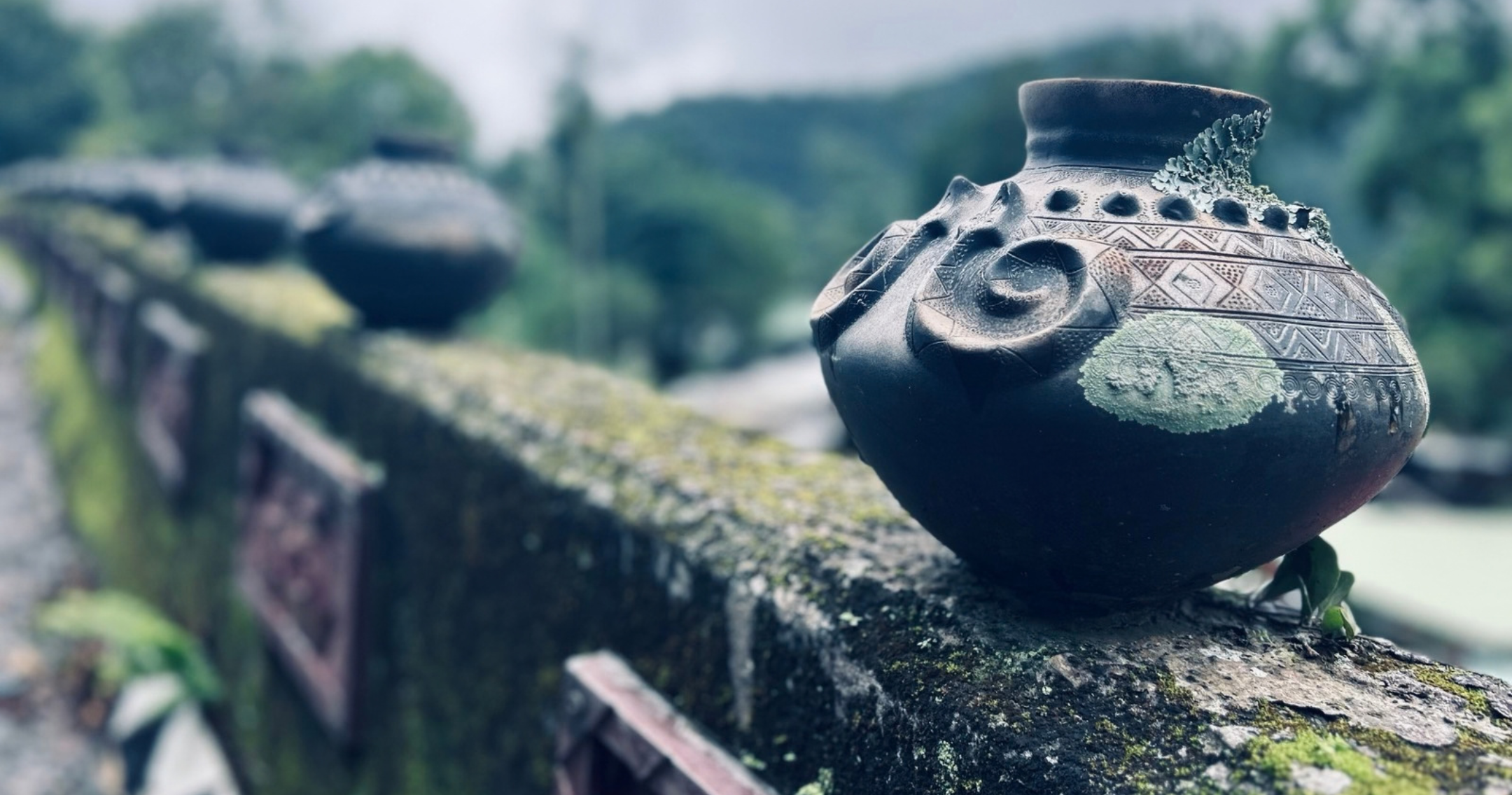
Photo: Replica of a decorated ceremonial jar of the Paiwan Indigenous people, Taiwan, photo by Olimpia Kot, EVC.
What is happening?
Taiwan is expanding its Indigenous cooperation across the Pacific. In September, Taiwan’s Council of Indigenous Peoples (CIP), Kamehameha Schools, a private, charitable educational trust for Native Hawaiians, the Indigenous Polynesian people of Hawaiʻi, and the Polynesian Voyaging Society signed the Declaration of Austronesian Kinship and Pacific Unity in Honolulu.
The agreement focuses on Indigenous language and cultural revitalization, traditional navigation, education and sustainable development, and envisages further exchanges, including a future visit to Taiwan by the Polynesian Voyaging Society’s Hōkūleʻa fleet. The Hōkūleʻa is a type of double-hulled voyaging canoe that was launched in 1975 to test the theory that Austronesian peoples first migrated by sea from Asia.
The declaration adds to a growing network connecting Taiwan’s Indigenous peoples with Indigenous communities and institutions across the Pacific and beyond. Taiwan’s 17 officially recognized Indigenous groups today account for approximately 3% of the country’s population, yet their international connections have acquired significance well beyond their demographic weight. For Taiwan, whose formal diplomatic space remains constrained, these networks provide channels of international engagement that do not depend exclusively on diplomatic recognition.
What is the broader picture?
Taiwan’s Indigenous languages belong to the Austronesian language family, extending across Island Southeast Asia and the Pacific to Aotearoa New Zealand, Hawaiʻi and Rapa Nui, and westward to Madagascar. These linguistic and historical connections increasingly underpin cooperation on issues ranging from cultural and language revitalization to trade, education and natural-resource governance.
One of the most developed relationships is with New Zealand. Indigenous cooperation was incorporated directly into the 2013 ANZTEC economic agreement, giving relations between Māori and Taiwan’s Indigenous peoples an unusually formal position within a bilateral trade framework. The agreement, which marked its 10th anniversary in 2023, consists of 25 chapters, with Chapter 19 devoted specifically to Indigenous cooperation. Taiwan subsequently joined New Zealand, Australia and Canada in the Indigenous Peoples Economic and Trade Cooperation Arrangement (IPETCA), which promotes Indigenous participation in international trade and is explicitly intended to be Indigenous led.
The relationship with New Zealand is moving beyond cultural exchange. Geothermal development provides one example: Significant geothermal resources in both Taiwan and New Zealand overlap with Indigenous territories, making questions of consultation, land rights, benefit-sharing and participation in resource governance relevant to communities in both countries.
Elsewhere, Taiwan has institutionalized cooperation with the Marshall Islands through a 2019 agreement covering culture, language and traditional knowledge, while the revived Austronesian Forum provides a broader platform for regional cooperation. Beyond the Austronesian world, a 2026 MOU formalized relations with Japan’s Ainu people. The latest agreement with Native Hawaiian institutions further extends this network into language revitalization, education and traditional navigation.
Taken together, these initiatives show that Indigenous cooperation is no longer confined to cultural diplomacy. It now encompasses economic participation, education, environmental governance and resource management, while creating transnational relationships that can operate alongside conventional diplomacy.
Why is it important?
The expansion of these networks reflects a broader shift in the position of Taiwan’s Indigenous peoples, from subjects of state policies toward increasingly active participants in shaping their own international engagement.
In the past, Taiwan incorporated Austronesian connections into external engagement, to position Taiwan outside a China-centered framework, while risking the instrumentalization of Indigenous peoples and their histories. Beijing, meanwhile, advances a competing narrative of shared ancestry and historical connection to China, challenged by Taiwan’s Council of Indigenous Peoples (CIP), the ministerial-level body responsible for Indigenous affairs, as an attempt to incorporate Taiwan’s Indigenous peoples into a Chinese national narrative.
At the same time, expanding networks of Indigenous cooperation have begun to exceed these state-centered frameworks. Their significance lies precisely here, while strengthening Taiwan’s international presence, they also create greater space for Indigenous peoples to shape the relationships, priorities and narratives through which they engage internationally.