

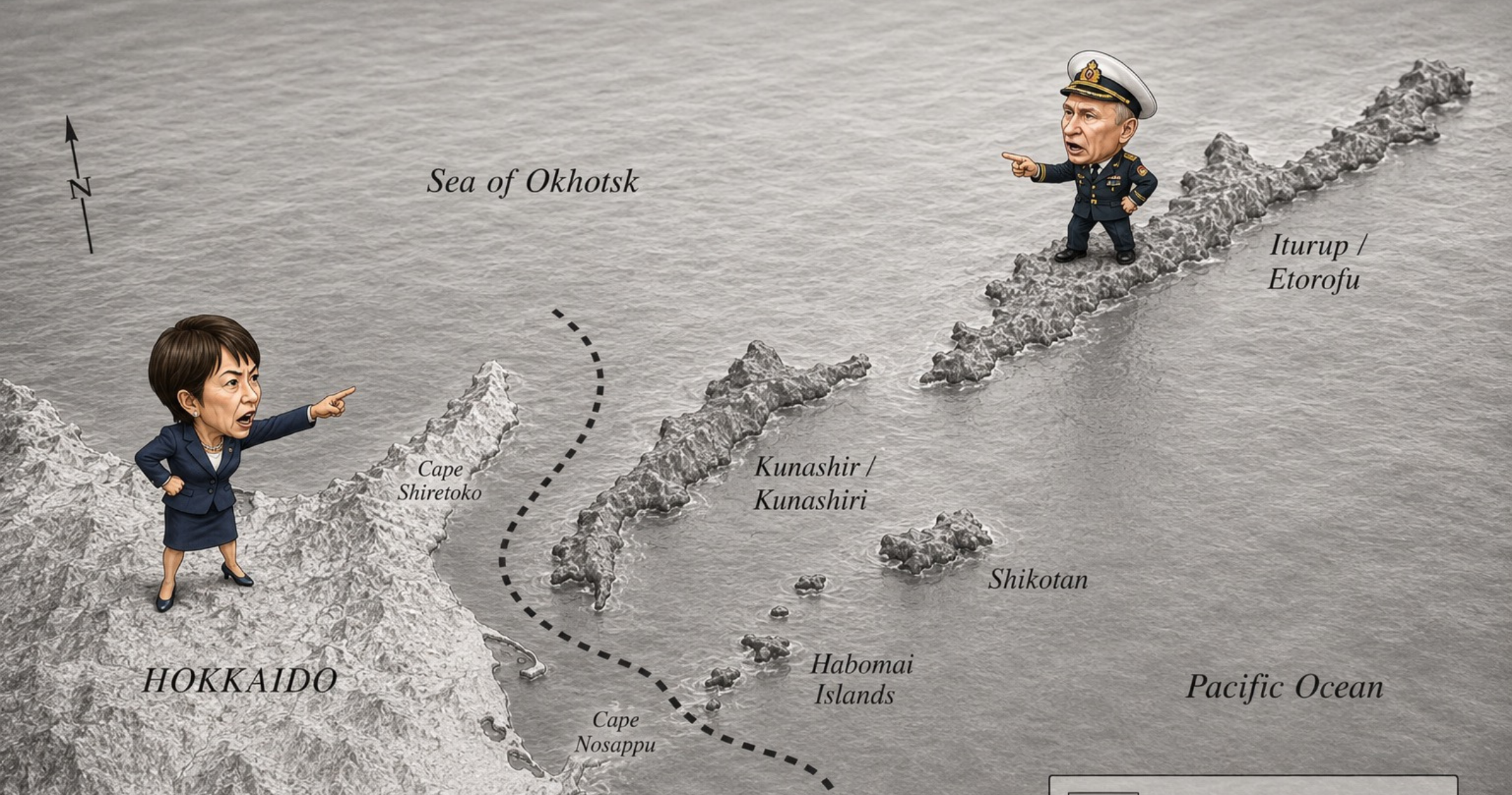
Photo: Generated AI, ChatGPT
What is happening?
A new diplomatic crisis has emerged between Japan and the Russian Federation. The current conflict was sparked by Russian President Vladimir Putin’s visit to Iturup Island (known in Japanese as Etorofu), which is the subject to a territorial disputebetween Tokyo and Moscow. The largest of four islands claimed by Japan, Iturup is located at the southernmost part of the Kuril chain, which has been under Russian control since 1945. The dispute has been a persistent source of friction and remains the main obstacle to a formal peace treaty between the two countries.
Tokyo considers the so-called Northern Territories (北方領土) an inherent part of Japan and therefore heavily criticised Putin’s presence there, warning that Russo-Japanese relations would be difficult to restore after the incident. Yet it appears that the Kremlin has intended to deliver several broader messages with the visit.
What is the broader picture?
The Northern Territories dispute concerns Iturup, Kunashir, Shikotan and the Habomai islets, the closest of which lie less than 4 km from Hokkaidō. Moscow argues that they legitimately became Soviet possessions following WWII, when Japan renounced the Kuril Islands. Japan, however, maintains that the 1855 Treaty of Shimoda established the Russo-Japanese border north of Iturup and that the four territories, none of which had previously been under Russian control, were therefore not part of the claims it later relinquished. Tokyo consequently regards them as Japanese territory currently under Russian occupation. Notably, although the 1956 Soviet-Japanese Joint Declaration ended the state of war and restored diplomatic relations, the unresolved sovereignty dispute has prevented the two countries from signing a peace treaty to this day.
Against this backdrop, Putin’s August 13 trip to Iturup, around 100 kilometres from Hokkaidō, marked his first visit to the Kurils during his 26 years in power. A presidential visit constitutes a powerful symbolic assertion of sovereignty, presenting the territory as an ordinary part of the Russian state. His previous avoidance of the area, despite Moscow’s policy of strengthening the Far East since 2013, reflected its political sensitivity and importance for a future peace treaty. Such a change in approach suggests that the Kremlin is treating its sovereignty over the islands as non-negotiable rather than seeking to preserve a conciliatory relationship with Japan.
Moreover, Putin had observed Russia’s Pacific Fleet exercises around Sakhalin Island, west of the Kurils, just a day earlier, giving the trip a definitive military dimension and demonstrating Moscow’s continued attention to its eastern frontier. This comes amid a broader military build-up in the region, with Russia holding combat drills and deploying advanced coastal missile systems, including Bastion launchers, across the Kurils and on Iturup itself.
The visit quickly triggered a tit-for-tat diplomatic response. Tokyo summoned the Russian ambassador, while Moscow rejected the protest, insisting that its president could travel freely within Russian territory. Moscow subsequently summoned the Japanese ambassador, while Russia’s Minister of Foreign Affairs Sergey Lavrov escalated the rhetoric, accusing Japan of pursuing an “openly aggressive, militaristic line.” Russian officials also explicitly linked the worsening relations to Tokyo’s alignment with the West and its support for Ukraine, warning that Japan’s continued assistance to Kyiv could further damage relations with Moscow. The confrontation therefore also serves as a warning to Japan that its Ukraine policy carries consequences.
Why does it matter?
Despite its ongoing war in Europe, Russia is not leaving its eastern territories unattended. Putin’s visit highlights the Far East’s growing strategic importance as Moscow turns towards Asia and the Arctic amid deteriorating ties with Europe. The region offers access to the Pacific, natural resources and increasingly important partners such as China and North Korea, while Russia continues strengthening its regional military presence.
Putin’s Iturup visit can therefore be read as delivering three interconnected messages: to Japan, that Moscow considers its sovereignty over the islands non-negotiable; to the wider region, that Russia intends to consolidate its position as an Asian power; and to officials in Tokyo specifically, that its support for Ukraine comes at the expense of relations with Russia.