

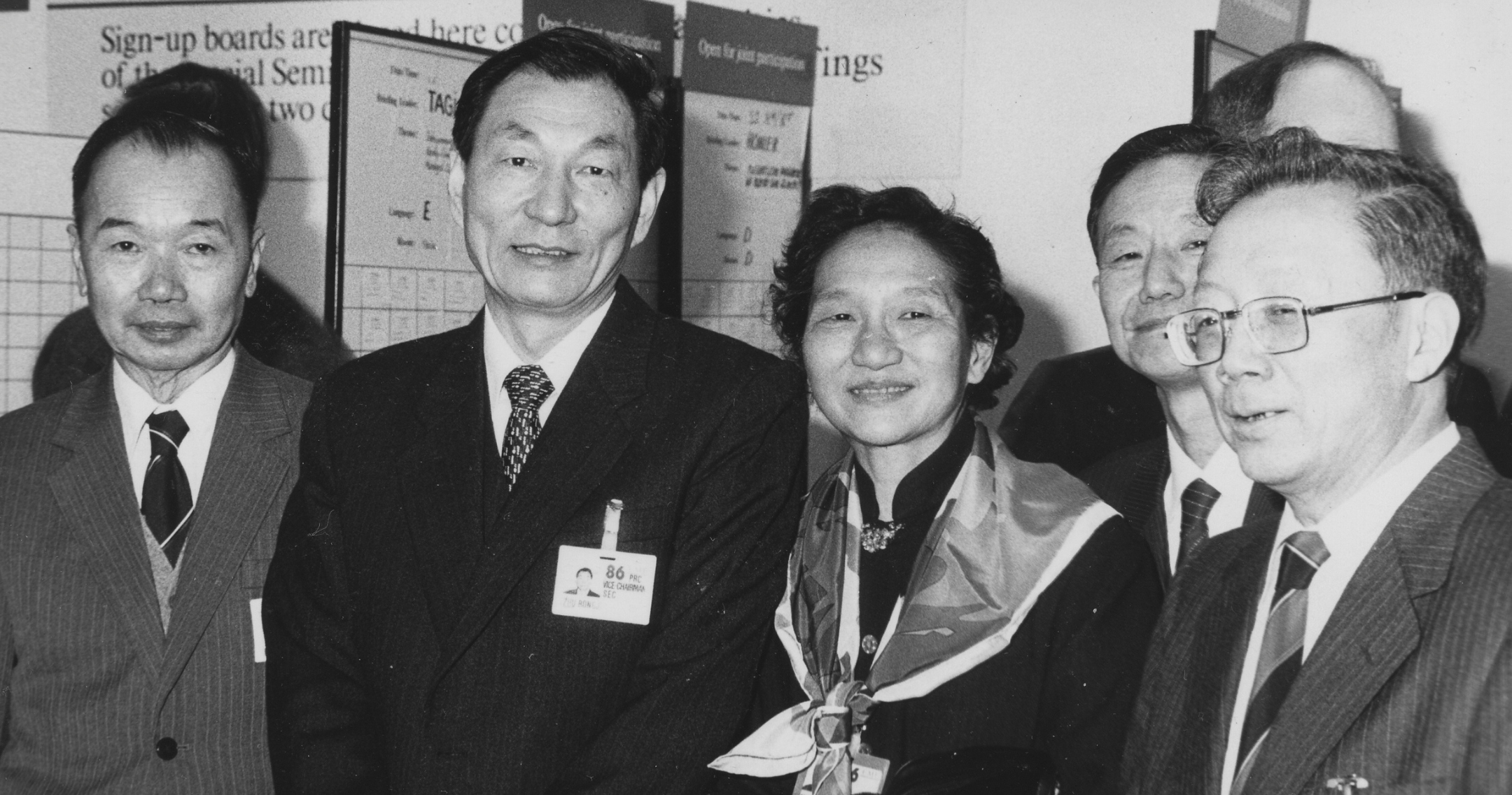
Photo: Zhu Rongji (second left), vice-chairman of China’s State Economic Commission and future premier (1998 – 2003), leading the Chinese delegation at the European Management Symposium, the predecessor of the World Economic Forum in Davos in 1986. Source: Flickr
What is happening?
Last week, China bid farewell to one of its most influential economic reformers, former Premier Zhu Rongji (朱镕基) died at the age of 97 after an undisclosed illness. President Xi Jinping (习近平) and the other members of the Politburo Standing Committee attended the closely managed farewell ceremony and cremation at Babaoshan Revolutionary Cemetery in Beijing on 18 August, while security was tightened around central Beijing.
Public expressions of grief were also closely monitored, particularly when they evoked nostalgia for the reform-oriented period of the 1990s and early 2000s when Zhu served as premier under President Jiang Zemin (江泽民) — the so-called Jiang-Zhu era.
What is the broader picture
Chinese state media described Zhu as “an excellent Party member, a time-tested and loyal communist fighter, and an outstanding proletarian revolutionist, statesman and leader of the Party and the state.” The wording followed the formal conventions used in the obituaries of former premiers Li Peng (李鹏, 1928-2019) and Li Keqiang (李克强, 1955-2023). However, Zhu’s obituary was longer and included explicit praise for his personality, describing him as someone who had the courage to speak the truth, accept responsibility and avoid seeking special privileges.
Despite being persecuted twice under Mao Zedong (毛泽东) — he was labeled as “rightist” in the Anti-Rightists Movenment of 1957, expelled from the Chinese Communist Party and then sent to work in the countryside during the Cultural Revolution (1966-76) — he remained loyal to the CCP and, when politically rehabilitated after Mao’s death, he returned to economic policymaking.
Zhu became one of the principal architects and implementers of China’s economic reforms during the 1990s and early 2000s. As Shanghai’s mayor and Party secretary between 1987 and 1991, he promoted industrial restructuring, infrastructure improvements and the development of Pudong, helping lay the foundations for Shanghai’s emergence as an international financial center. Later, as vice premier and premier, he played a decisive role in completing the negotiations that led to China’s 2001 accession to the World Trade Organization.
The reforms also produced significant social and fiscal costs. The restructuring of state-owned enterprises led to massive layoffs, while inflation reached approximately 24.3% in 1994. Tax-sharing reforms that same year strengthened the central government’s finances but left local governments with extensive spending responsibilities. This contributed to fiscal imbalances and, over time, to greater reliance on land sales and borrowing.
As Jiang’s right hand man, Zhu was known for his tough, pragmatic stance, earning him the soubriquet the “iron-fisted premier.” His death came just days before the CCP commemorated the centenary of Jiang’s birth on August 17, followed by Zhu’s farewell ceremony the day after. The timing appears to have intensified public nostalgia for the Jiang–Zhu era of rapid growth, market-oriented reform and opening. However, nostalgic accounts often overlook the above-mentioned costs and drawbacks of the economic reforms, recalling instead the benefits of the boom, greater openness to the global economy and a leadership style that appeared more candid and relatable.
Zhu retired in 2003 and, despite note being politically active, he remained one of the most popular Chinese officials until his death.
This popularity extended beyond China, as Zhu was respected internationally for his blunt, candid and humorous exchanges with journalists, often delivered in remarkably proficient English.
Why does it matter?
Zhu Rongji represented a generation of CCP leaders who were purged under Mao, later rehabilitated and then enlisted to spearhead the reform and opening-up project. Together with Deng Xiaoping (邓小平) and Jiang Zemin, this generation helped transform China’s economic system, integrate the country into global trade and establish the foundations for several decades of rapid growth.
At the same time, the current leadership has carefully controlled the public commemoration of former leaders. The authorities are sensitive to the possibility that mourning may develop into criticism of the present political order. In 1976, public mourning for Premier Zhou Enlai (周恩来) contributed to the April Fifth Movement in Tiananmen Square. In 1989, the death of former Party General Secretary Hu Yaobang (胡耀邦) helped trigger demonstrations that eventually culminated in the Tiananmen Square massacre.