

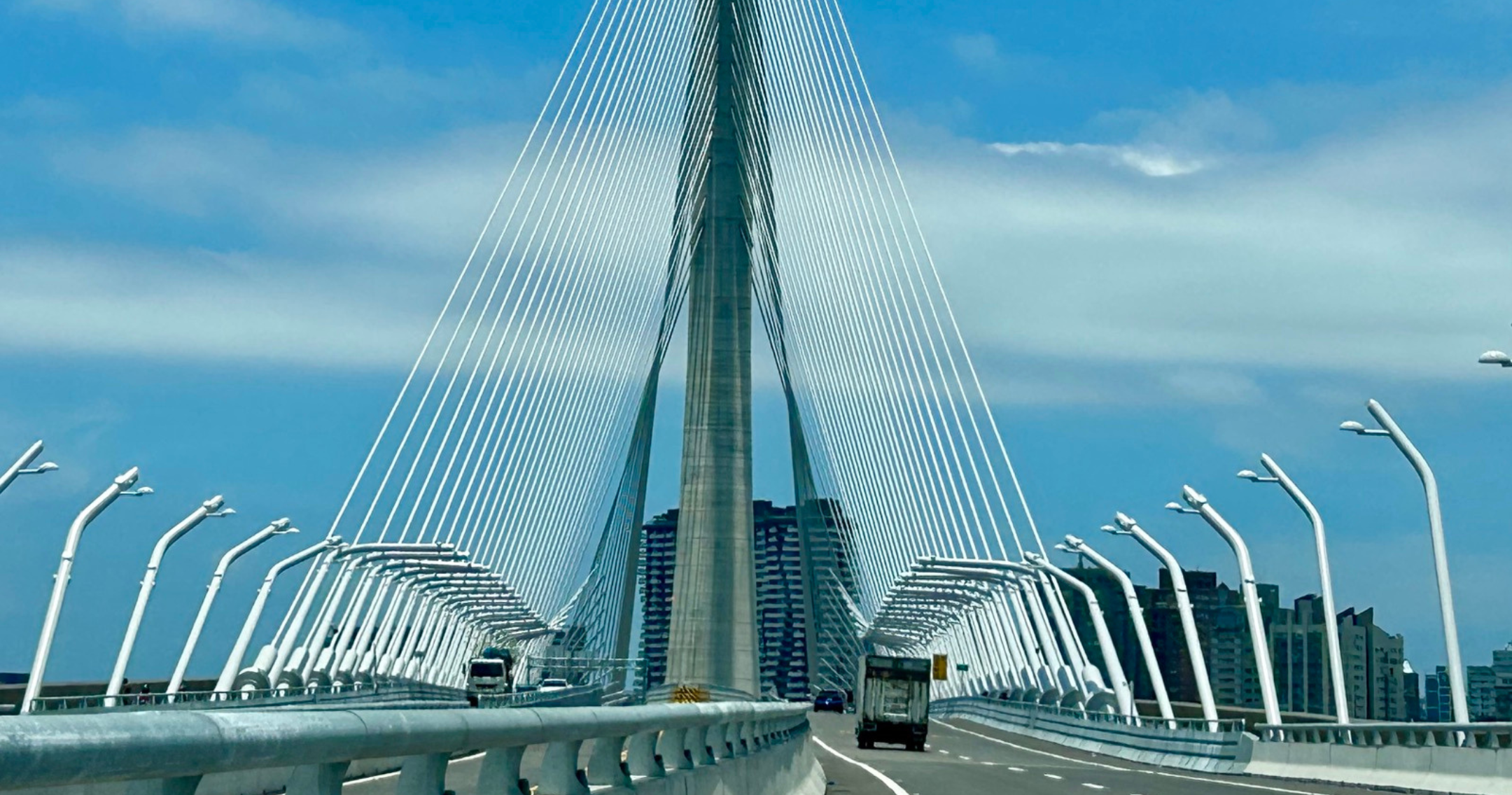
Photo: Danjiang Bridge, site of August 2026 blockage drills, by Olimpia Kot, EVC
What is happening
Taiwan has launched its annual Han Kuang military exercise (漢光演習), August 5, beginning 10 days of drills. The 42nd edition of the exercise is designed to test the combat readiness of Taiwan’s Armed Forces and strengthen battlefield command and coordination through scenarios that include air-raid drills and temporary slowdowns of mobile internet services. The exercise comes amid sustained military pressure from China, which has been intensifying near-daily deployments of fighter jets, warships, and coast guard vessels around Taiwan. This year, the exercise is also being conducted alongside broader efforts to strengthen whole-of-society defense resilience.
What is the broader picture?
Held annually since 1984, the large-scale exercise is conducted in two stages. This year’s edition of the tabletop war games took place from April 11 to April 24. The live-fire phase, currently underway, expands beyond the battlefield and introduces several elements not seen in previous exercises. The exercise is also visible on the streets, with 5,000 reservists mobilized this year, compared with 3,000 last year.
As part of this year’s exercise, mobile network services will be disrupted for the first time, further extending the drills beyond the battlefield into the civilian environment. This builds on the shift toward greater practicality introduced in 2025, when the exercises featured unscripted urban warfare scenarios for the first time, including troops using Taipei’s metro system. Taken together, these changes reflect a growing recognition that a conflict could be prolonged and extend beyond the traditional battlefield into densely populated urban areas and civilian infrastructure.
This year’s Han Kuang drills are being conducted alongside Urban Resilience (Air Defense) Exercises, which cover alarm transmission, evacuation and sheltering, traffic control, and disaster response across all Taiwan’s regions, taking place sequentially across the southern, central, offshore island, eastern, and northern regions. Each region will conduct a 30-minute drill. Combining the Han Kuang and resilience drills would test the ability of military, civilian, and political leaders to make and execute decisions quickly and effectively under pressure.
While Taiwan began integrating civilian resources into national defense under former President Tsai Ing-wen (蔡英文), civilian territorial defense remained secondary to asymmetric military defense. The All-Out Defense Mobilization Agency (ADMA, 全民防衛動員署), established in 2021, initially focused primarily on military reserve mobilization. The agency’s mandate has expanded under the administration of Tsai’s successor, President Lai Ching-te (賴清德), including through the merger of the Wanan (萬安) and Minan (民安) drills into the Urban Resilience Exercises held alongside Han Kuang.
This integration is expected to strengthen coordination between the Ministry of National Defense and civilian agencies, including the National Police Agency, while also expanding private-sector participation. For example, PX Mart, Taiwan’s largest supermarket chain, participated in a simulated missile attack and power outage, and there are plans to further involve businesses in resilience exercises to strengthen civilian preparedness.
Why is this important?
This year’s Han Kuang exercise illustrates how Taiwan is gradually expanding the scope of its defense readiness beyond conventional military operations. The increasing use of urban environments, civilian infrastructure, communications disruptions, and coordination with civilian authorities reflects the reality that a conflict would not be confined to the battlefield. For Taiwan, the ability of military and civilian institutions to coordinate under pressure will be an important part of sustaining operations and maintaining essential services during a crisis.
The exercise also raises questions about the extent to which Taiwan’s preparedness framework should reflect the society it is intended to protect. With more than 800,000 migrant workers playing an essential role in caregiving and key sectors of the economy, their needs and roles in a crisis could become an increasingly relevant consideration in future preparedness planning. More broadly, the expansion of Han Kuang into the civilian sphere highlights the practical challenges of coordinating across government agencies, local authorities, businesses, and different segments of society.
Ultimately, the significance of this year’s exercise lies not only in the military capabilities it tests but in how effectively Taiwan can connect military readiness with the day-to-today functioning of society. As Han Kuang continues to incorporate more realistic and complex scenarios, the exercise provides an important indication of how Taiwan is adapting its defense preparedness to the possibility of a prolonged, multidimensional crisis.