

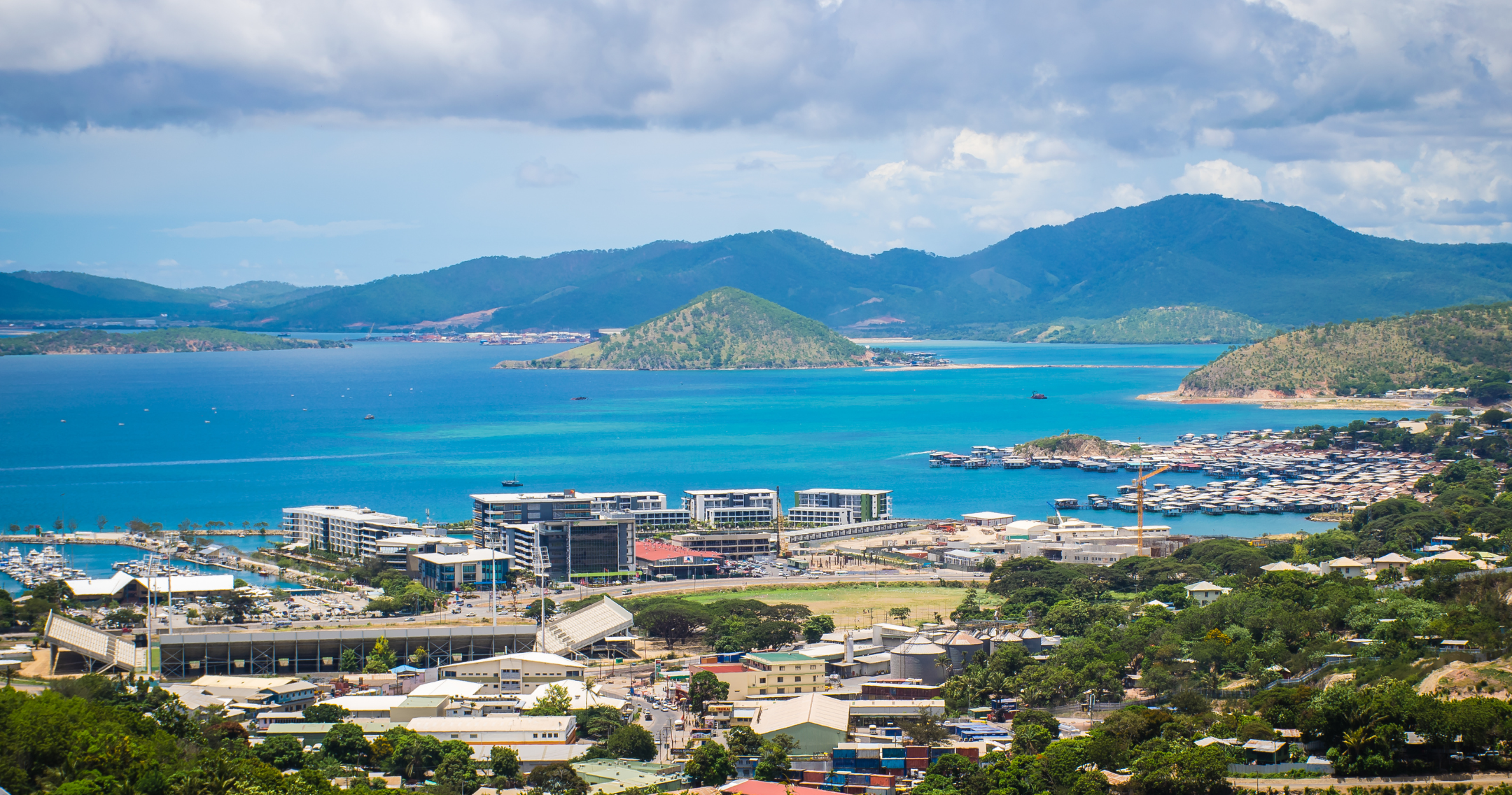
Photo: City view of Port Moresby (licensed from Getty Images)
Papua New Guinea’s (PNG) decision to shutter Taiwan’s representative office shows how Beijing’s “lawfare” against Taiwan works in practice. To respond, Taiwan should bring Pacific Island countries into the New Southbound Policy, its de facto Indo-Pacific strategy, and develop region-specific human security programs with democratic partners.
The statement announcing the office closure, issued by Port Moresby’s foreign minister, Justin Tkatchenko, explicitly frames the move as an effort to “uphold Papua New Guinea’s foundational ‘one China policy.’” Yet adherence to a “one China policy” does not preclude robust, informal ties with Taipei in economic, social, cultural and development cooperation.
Formulations of a “one China policy” that undermine informal ties with Taiwan echo Beijing’s “one China principle,” which claims Taiwan as part of the People’s Republic of China and falsely presents this as an “international consensus.”
Pacific island countries have long been an area of diplomatic contestation between Taipei and Beijing. While three of Taipei’s 12 remaining diplomatic allies are in the region, Beijing has intensified its outreach there. China’s footprint includes development finance, infrastructure projects and diplomatic recognition campaigns with a more ambitious push for policing cooperation, security agreements, military access, resource extraction and the normalization of a sustained Chinese strategic presence across Oceania.
This outreach also includes legal warfare against Taiwan: At the Third China-Pacific island Countries Foreign Ministers’ Meeting last year, Beijing folded its distorted interpretation of UN Resolution 2758 into language on sovereignty and territorial integrity, presenting support for China’s claim over Taiwan as part of a wider bargain of mutual respect for Pacific island countries’ own sovereignty.
The immediate question is how Taiwan should respond to PNG. The larger question is how Taiwan should prevent similar pressure from succeeding elsewhere in Oceania.
Unsurprisingly, liquefied natural gas (LNG) is becoming the center of Taiwan’s possible response. Minister of Foreign Affairs Lin Chia-lung (林佳龍) has signaled that Taipei is reviewing its purchases of Papua New Guinean gas after Port Moresby’s unilateral decision to shutter Taiwan’s representative office, suggesting that the first layer of retaliation would be economic. By placing LNG on the table, the government can show Taiwanese audiences that it is defending national dignity through material leverage rather than rhetoric alone.
Taipei has leverage, but not cost-free leverage. The nation reportedly buys around one-third of PNG’s LNG exports, while PNG accounts for only about 5 percent of Taiwan’s LNG imports. Substitution would still require planning, but the asymmetry matters: losing Taiwan as a buyer would be a more painful loss for Port Moresby. Yet, the issue extends beyond PNG. Taiwan’s energy security remains one of its most acute vulnerabilities. Uncertainty around the Strait of Hormuz and Qatari LNG deliveries reinforced the need to diversify suppliers, routes and contracts.
Precisely because LNG leverage is tactical, it should be nested in a wider strategy rather than treated as the strategy itself. China is working to pull PNG, the largest and most influential Melanesian country, deeper into its political, economic and security orbit: weakening Australia’s footprint, gaining early access to untapped mineral resources, positioning itself in vital maritime and digital-connectivity space, and expanding law-enforcement and military cooperation in ways that could reduce Australian and US strategic visibility. PNG retains agency, but Beijing is trying to reshape the costs and incentives Pacific governments face.
Taiwan’s response therefore needs to move beyond reactive retaliation. Taipei should join a broader coalition offering a non-corrosive alternative to China’s predatory outreach in Oceania.
Taiwan already has the raw material for such an approach. Its international cooperation model, elaborated in the 2023 White Paper on International Cooperation and Development Policies, is built around realizing sustainable development goals, boosting human security and fostering public-private-civil society participation, all underpinned by strong respect for context-specific needs of partner countries. These are precisely the elements of a non-corrosive alternative: development that is locally useful, transparent, technically grounded and people-centered rather than transactional or coercive.
The missing element is architecture. Taiwan’s development cooperation in the Pacific has often been practical and appreciated, but insufficiently embedded in a broader regional strategy. The New Southbound Policy still fails to adequately include the Pacific islands, despite their relevance to Taiwan’s diplomatic space, maritime and energy security and Indo-Pacific strategy. That gap is increasingly difficult to justify. There is no credible Indo-Pacific policy that treats Oceania as an afterthought.
Taipei should leverage its strengths by partnering with others already offering choices in the region, including the EU’s Global Gateway initiative, Japan’s quality infrastructure agenda, and Australia’s and New Zealand’s regional engagements. Their common logic is higher standards, greater transparency and stronger local ownership in infrastructure, connectivity, climate resilience, health, educatiom and digital capacity.
For Taiwan, the point of convergence should be practical rather than declaratory. Taipei can contribute where it has comparative advantages: healthcare digitization, agriculture, aquaculture, food security, logistics, technical training, small and medium-sized enterprise development, digital connectivity and community-level capacity-building. These are not peripheral issues. In Pacific island countries, they are the substance of human security. They also create relationships that are harder for Beijing to displace through pressure, elite capture or legal warfare.
This is why Taiwan’s response to PNG should not stop at LNG. Economic leverage might be necessary to signal that unilateral actions carry costs, but retaliation alone cannot build durable influence. Taiwan needs a Pacific islands strategy that expands local room to maneuver through concrete, non-corrosive options: food security without dependency, digital connectivity without political control, healthcare modernization without coercive conditionality and infrastructure cooperation without opaque debt or strategic capture.
Taiwan’s challenge is therefore not only to defend its representative offices, diplomatic allies or legal position on UN Resolution 2758. It is to ensure that its presence in Oceania is sufficiently institutionalized, partnered and socially embedded that Beijing cannot extinguish it by applying pressure to one capital at a time.
Author:
- Marcin Jerzewski 葉皓勤 is head of the Taiwan office of the European Values Center for Security Policy and a fellow at Visegrad Insight.
This article was originally published in Taipei Times.