

Photo: Made in Canva.com
What is happening?
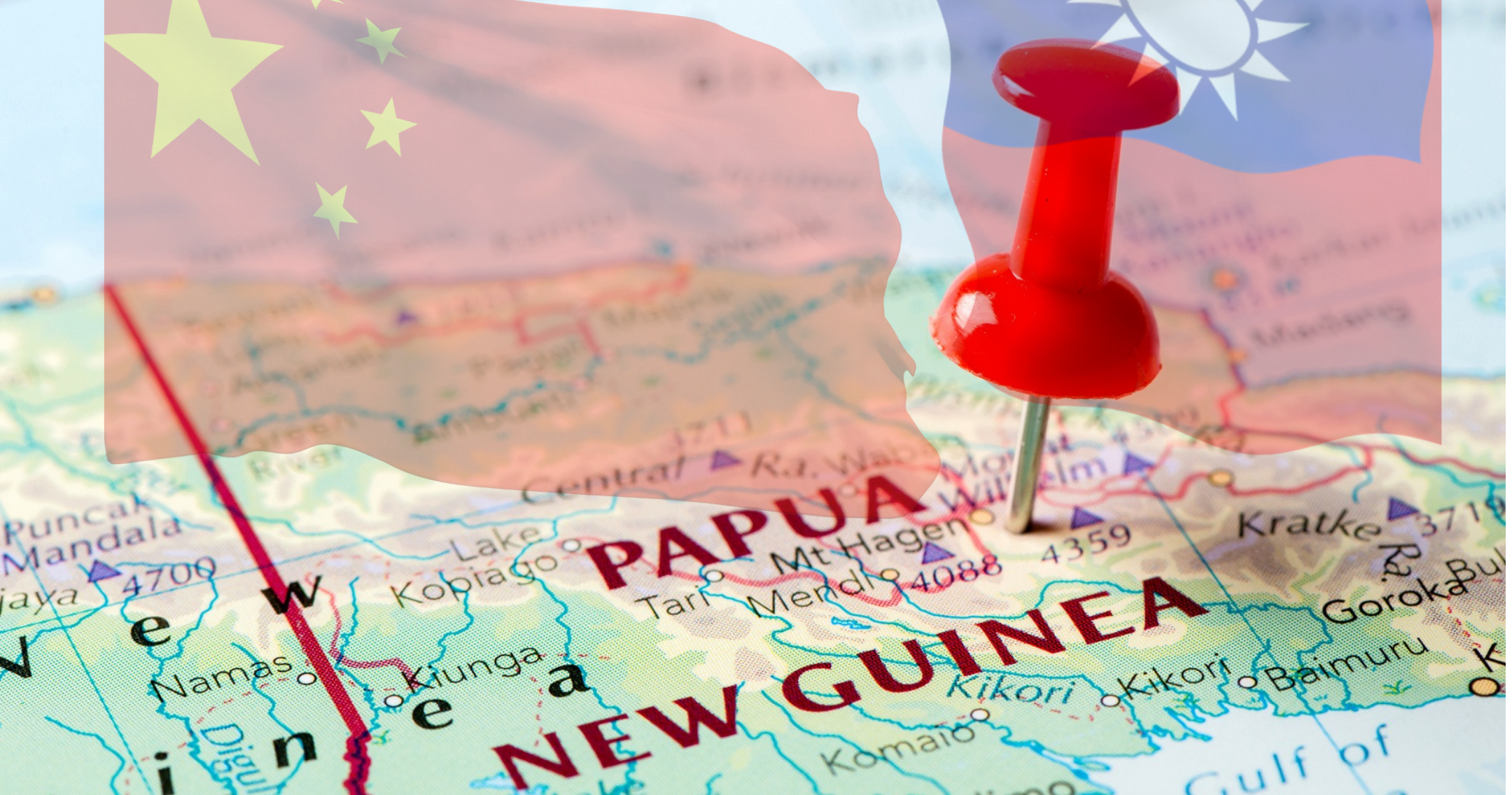
Papua New Guinea (PNG) has ordered Taiwan’s office in Port Moresby to close, with Foreign Minister Justin Tkatchenko framing the move as compliance with the country’s “one-China policy.” Taipei rejected the decision, said there had been no prior consultation, kept the office operating, and began reviewing bilateral ties, including imports of liquified natural gas (LNG) from PNG. Taiwanese officials also suggested the move may not reflect full cabinet consensus in Port Moresby.
The dispute matters because it shows how lawfare—the use of legal and diplomatic language to narrow Taiwan’s international space—travels into the Pacific. Beijing quickly welcomed the closure, while Washington called it part of a wider intimidation campaign against Taiwan’s partners. PNG is therefore more than a bilateral diplomatic spat; it is a test case for how pressure on Taiwan is being localized in Oceania.
What is the broader context?
The context is more layered than simple bloc politics. PNG has deepened security ties with Australia through the 2023 bilateral security agreement and the 2025 mutual defence Pukpuk treaty, both of which stress sovereignty, transparency, and regional stability. But Pacific governments do not treat such deals as exclusive—hedging with Beijing continues even after new agreements with Canberra. That matters because PNG is the largest Melanesian state and a pivotal node in southwest Pacific competition over infrastructure, policing, and maritime access.
China’s approach is also broader than aid or protocol. At the 2025 China–Pacific Island Countries Foreign Ministers’ Meeting, Beijing inserted its reading of UNGA Resolution 2758 into sovereignty language tied to mutual respect for Pacific states, effectively linking their own territorial concerns to China’s Taiwan claim. This is classic lawfare: using legal framing to normalize political outcomes favorable to Beijing.
For Taiwan, the immediate lever is LNG, but the deeper issue is energy security. Taiwan buys about 1.2 million tonnes of PNG gas annually—roughly one-third of PNG’s LNG exports, according to Taiwanese officials—so Taipei has some leverage. But the same episode also underscores Taiwan’s vulnerability in any blockade or quarantine scenario. In a series of table-top exercises conducted by the European Values Center for Security Policy, Taiwan’s energy security emerged as a primary concern in a China-led escalation scenario, alongside cyber disruption and the continuity of industrial production.
The strategic answer, however, cannot be retaliation alone. Taiwan already has development tools built around human security and technical cooperation, but the Pacific still sits awkwardly outside the core geography of the New Southbound Policy. A more credible approach would work through partners rather than around them. That is where the EU’s Global Gateway matters: Brussels is already financing port and water projects in PNG, including the modernization of Rabaul port, while its broader PNG offer spans transport, climate and energy, and rural development. A 2025 report by EVC analysts argues Global Gateway works best through convergence with like-minded Indo-Pacific partners, including Australia, Japan, New Zealand, South Korea, and Taiwan. In Pacific terms, that points to a non-corrosive alternative: practical cooperation on health, digital connectivity, agriculture, logistics, and climate resilience that expands local choice rather than dependency.
Why is it important?
The broader implication is that Pacific security is no longer only about bases, patrols, or treaty texts. It is also about who shapes legal narratives, critical infrastructure, supply routes, and the menu of external partnerships available to Pacific states. That gives the PNG-Taiwan dispute significance well beyond Port Moresby.
For Europe, the case is not peripheral. The EU is already invested in PNG through Global Gateway, and any successful Chinese effort to pull PNG more firmly into its orbit cuts against European interests in resilient connectivity, transparent infrastructure, and a rules-based Pacific. But Europe will not have the scale to respond alone. The practical lesson is coalition-based statecraft: work with Pacific governments, Australia, Japan, New Zealand, and Taiwan to make the region’s alternatives more visible, more useful, and more durable.