

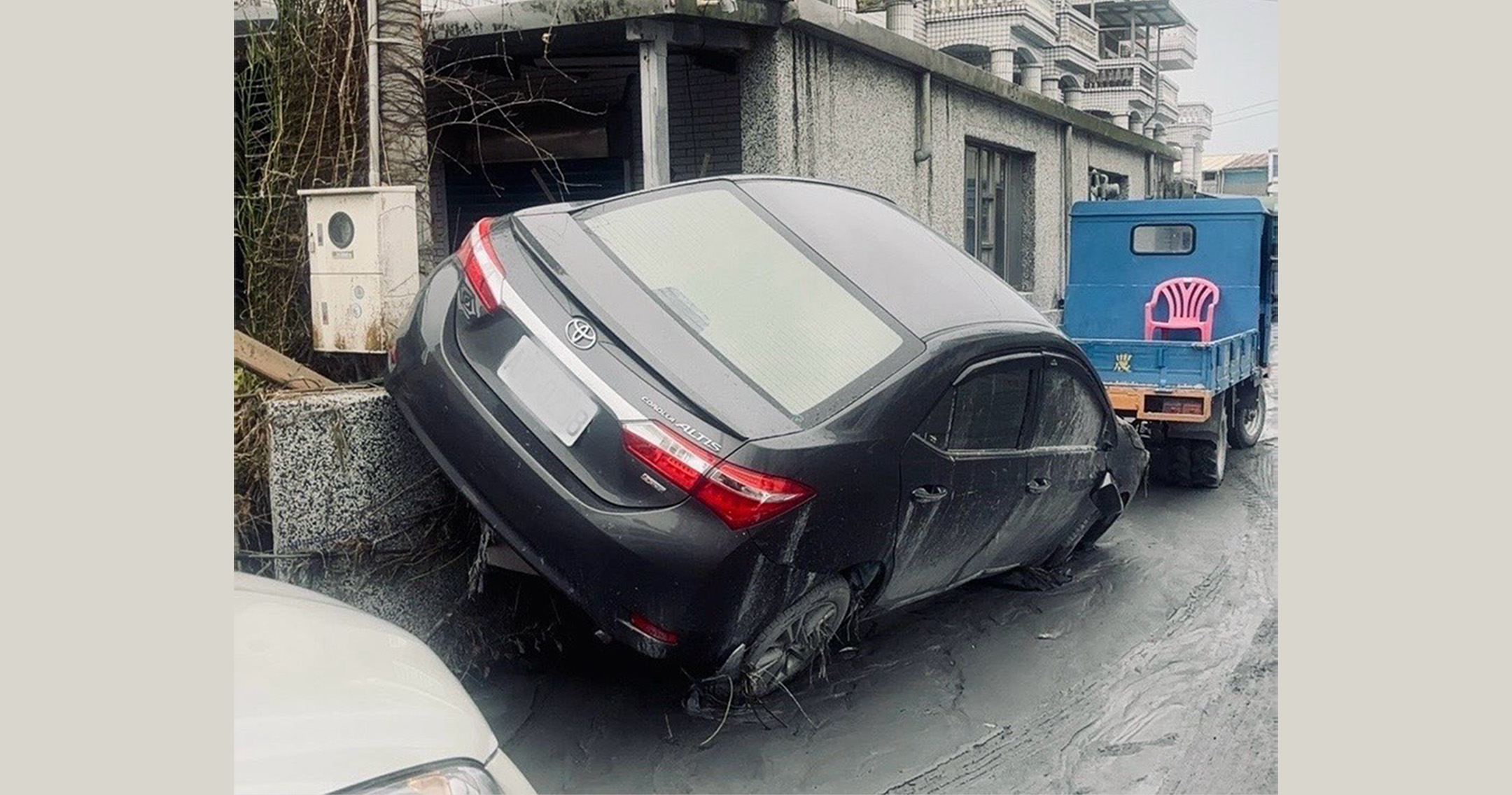
Photo: Guangfu Township, Hualien County by 張伃婷
What is happening?
On September 22, just over a month after Typhoon Podul caused large scale destruction in southern Taiwan, the country was subjected to the destructive impact of another tropical cyclone, Typhoon Ragasa, the eighteenth recorded this year by Taiwan’s Central Weather Bureau.
Although Taiwan is accustomed to the seasonal recurrence of typhoons, the overflow of a barrier lake formed on the Matai Creek in Hualien County during the year’s most powerful storm resulted in unprecedented devastation across three townships.
Beyond the immediate human tragedy, which included fatalities and missing people, the disaster rapidly became entangled in political contestation. Rival factions instrumentalized the crisis, deploying divergent narratives of responsibility and blame, concerning deficiencies in both preventive measures and emergency response capacities. Such politicization stands in marked contrast to the bottom-up mobilization of civil society, as large numbers of citizens and foreigners residing in Taiwan, including migrant workers, converged to participate in relief operations. Their spontaneous collective engagement underscores the resilience of local communities, even amid systemic governance failures and partisan exploitation.
What is the broader picture?
Situated within two monsoonal systems, Taiwan is accustomed to the seasonal rhythm of intense summer rainfall and recurrent typhoons. In this instance, however, an unanticipated chain of events unfolded. A barrier lake, a body of water produced when a river’s course is obstructed by landslide debris, overflowed with devastating force. The impounded waters of the lake that was formed on Matai’an Creek (馬太鞍溪) in July 2025, breached a downstream levee, pouring into the rural townships of Guangfu (光復鄉) and Wanrong (萬榮鄉), and the urban township of Fenglin (鳳林鎮), where Indigenous peoples comprise 55 % of the population. The floods resulted in 18 fatalities, most of them elderly residents who were unable to escape in time. The torrent of grey, sediment-laden water engulfed first floors of many buildings, even rising to second floors in many cases, transforming familiar domestic and communal spaces into no-go zones. Several days after the flood, six million tons of mud still covered the farmlands.
Volunteers arrived in their tens of thousands, some equipped with personal tools, helping to clear debris and prepare meals for the displaced. Media and the public have nicknamed them “supermen,” with some dubbed “shovel superheroes” and others “cooking heroes,” while rainboots have become a symbol of relief efforts.
The government deployed 10000 military personnel to assist in disaster response operations, while Minister of National Defense Wellington Koo (顧立雄) pledged that public services in Hualien would be restored in time for the Mid-Autumn Festival, one of Taiwan’s most significant ritual festivals.
Looking ahead, the authorities also announced preventive policy measures to enhance future preparedness. The Ministry of the Interior stated that evacuation alerts for large-scale mudslide and flood events, including those associated with barrier lakes, will henceforth be upgraded to tsunami-level warnings to convey a heightened state of emergency and ensure timely public response.
Amid ongoing disaster relief efforts, tensions have also surfaced between local and central authorities, particularly concerning the timeliness of evacuation warnings and the decision-making processes related to budget allocation for relief operations. This friction became particularly visible during Premier Cho Jung-tai’s (卓榮泰) official inspection of the disaster zone in Hualien, where he and legislator Fu Kun-chi (傅崐萁) engaged in a public confrontation over responsibility for the disaster management. Meanwhile, allegations emerged that local authorities had discouraged volunteer participation in relief operations, further highlighting the tensions surrounding coordination, authority, and civic engagement in Taiwan’s disaster governance framework.
Why does it matter?
The Hualien barrier lake flood reveals not only the environmental vulnerabilities but also the institutional and political fragilities that shape Taiwan’s disaster governance. As climate change intensifies the frequency and magnitude of extreme weather events, the boundaries between natural and political conflict are increasingly blurred. The competing narratives of responsibility and politicization of relief highlight persistent coordination challenges between local and central authorities. The flood further underscores calls for rethinking how Taiwan’s disaster response integrates civil society participation as an essential component of resilience, rather than as a substitute for institutional capacity. Ultimately it serves as a reminder that effective disaster management in Taiwan must go beyond engineering and logistics to address trust, accountability, and inclusion within the broader framework of democratic governance.